
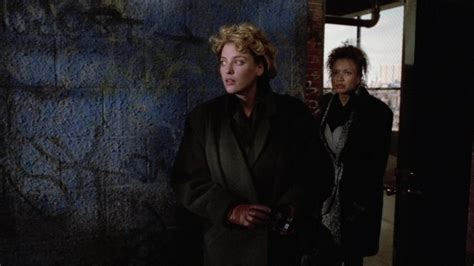
I was aware of Candyman’s racial impact before having seen the movie, although I hadn’t truly grasped it before last night’s screening. I was aware of the 2018 remake by Nia DaCosta that aimed to more fully tackle the racial elements of the 1982 film, but all I had heard was that it failed to capture the spirit of the original. But now that I have seen the original film, I have some complicated feelings about it. While there are some progressive elements to the film, like how the Cabrini-Green residents are humanized, there are also some questionable elements, especially regarding the relationship between Helen and Candyman.
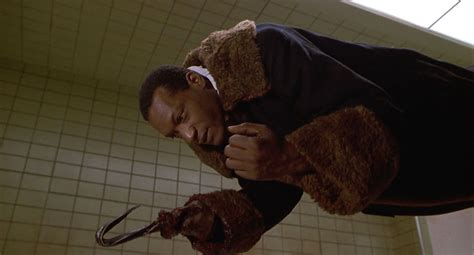
I got the sense that there were odd undertones of prostitution in Helen and Candyman’s relationship. While there aren’t any visible prostitutes onscreen, Candyman’s costuming definitely is reminiscent of popular depictions of Black pimps in mainstream media, with the lavish mink coat and the expensive shiny boots he wears. Helen also appears to be a representation of a “nice girl walking through a dangerous neighborhood,” a racist narrative that has been used to paint Black neighborhoods as rife with criminality and prostitution. But Candyman is still given a sympathetic, albeit romanticized backstory, and he is also the closest character in the story to empathize with Helen after her traumatizing fall from grace. In this sense, the victim and the violator are positioned as something close to partners. However, the climax of the film paints their relationship in a more threatening light, especially with the sexual undertones that play into racist stereotypes of Black men being more sexual than “virginal” white women.
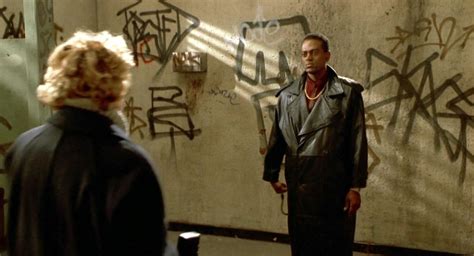
As Helen starts to lose every facet of her life after being arrested for the death of Bernadette and the kidnapping of Anne Marie’s baby, she ends up back in the Cabrini-Green complex, this time venturing into Candyman’s lair. There, she properly meets the titular villain, and as he picks her up and takes her to the table, he takes his hook and slides it under her skirt. Despite knowing that he is responsible for many deaths, Helen gives into his influence, since she has no one left in her life to protect her. This also fits into a popular narrative of prostitution being the last resort for women who have no economic opportunities left. Considering the interracial relationship between Helen and Candyman, this also makes the prostitution narrative seem more threatening by the prospect of the Black Candyman being the more sexual compared to Helen’s reserved sexuality. As Aviva Briefel and Sianne Ngai point out, “In the absence of the mediating figure guaranteeing the social validity of their alliance, the relation between Helen and Candyman is made to reflect the illegitimacy of miscegenation in the original story,” (Briefel 299). At the end of the story, Helen is depicted as a martyr akin to Joan of Arc in a mural in the Cabrini complex, memorialized for helping save the baby she presumably kidnapped. However, Candyman is declared dead in a cathartic showdown that sees Helen reject the demands of her Black captor. It seems odd that the film acts both humanizing towards Black people living in poor tenement housing while also demonizing a figure that appears to be an epitome towards Black anger towards centuries of systemic racism. Moreover, Helen’s whiteness and femininity are seen as virtues, which position her as a traditional Final Girl that has to escape the morbid sexual clutches of her Black abductor. The prostitution element also adds some discomfort, because we both feel for Helen’s situation while also fearing for her during her final interaction with Candyman.

This article was originally written for MS140 PO-01 Screening Violence, taught at Pomona College by Prof. Kevin Wynter.
 BEYOND THE FRAME
Leave a comment