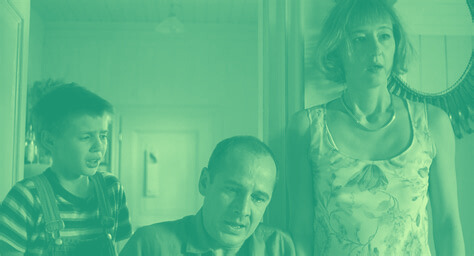
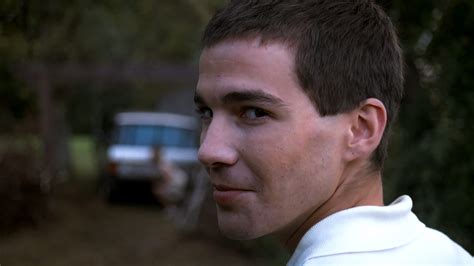
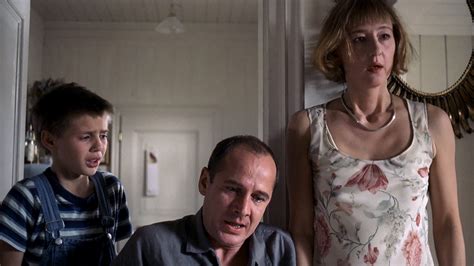
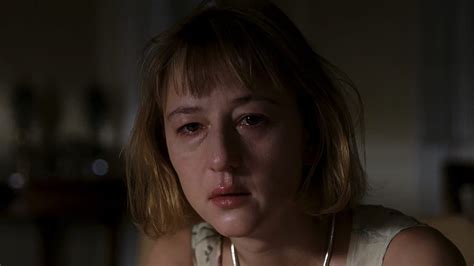
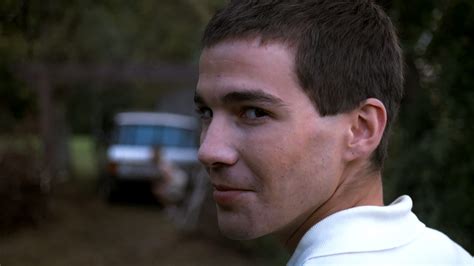
I had a very unpleasant time watching Funny Games (1997), which I now understand was the point. Unlike the other films we have seen in this class, director Michael Haneke deliberately sought for the audience to view the violence onscreen as bystanders. This is exemplified by Peter and Paul breaking the fourth wall to interact with the audience, slyly acknowledging how the audience wants their desire for gratifying violence to be fulfilled, and choosing to deny it, makes the audience the fourth hostage.
I found a lot of similarities between this film and the opening scene of A Clockwork Orange (1971), where a suburban couple’s idyllic life in the suburbs is rudely and brutally interrupted by a group of white-wearing teenagers with an affinity for violence. But whereas both films have obscene levels of violence, only one breaks the fourth wall, and that dramatically altered how I experienced both films. As Baudrillard points out, “This obscenity, this exhibitionist stand of terrorism, contrary to the opposite stand of secrecy in sacrifice and ritual, explains its affinity with the media, themselves the obscene stage of information. It is said that without the media there would be no terrorism,” (Baudrillard 43). In Orange, the violence felt more performative, and as a result I could take it somewhat suspend my disbelief, despite how brutal the violence was. But with Funny Games, there was a disturbing sense of closeness, like no matter what I did, I could not escape.
Paul and Peter know they’re in a film. It is as if Paul is earnestly asking the audience for their opinion on what is happening when he says, “You’re on their side, no?” Except in this instance, merely asking the question is an act of terrorism towards the audience. According to Baudrillard, hostages are “no longer the victim at all, since he is not the one who dies—he merely answers for the death of another. His sovereignty is not even alienated, it is congealed,” (35). This congealment of the audience’s response makes the film more terrifying, because we don’t know if we should blame the family for not cooperating with Paul and Peter or if we should punish ourselves for inadvertently aligning ourselves with the hostages. While it could be argued that cooperating with the hostage-takers is in our best interests, since they have all the power, the audience is also to blame. Paul and Peter know this. When they mention how the film isn’t at “feature-film length” yet at one point, they are acknowledging the medium driving the story. The medium of film is an omnipresent genre, where one can take in an entire world as if they are an all-seeing god. But part of this also means that one is to take in all the acts of violence committed in a film, and since film is used largely to entertain, one might expect to leave the movie theater reassured in their place in the world. In Funny Games, this luxury does not exist. Haneke takes the audience’s desire to be omnipresent in a film and traps the audience within it. If we are content with buying a ticket to see a horror film in which gruesome violence is inflicted on a family, then by Paul and Peter’s logic, we should sit on the couch and watch with them.
This article was originally written for MS140 PO-01 Screening Violence, taught at Pomona College by Prof. Kevin Wynter.
 BEYOND THE FRAME
Leave a comment