
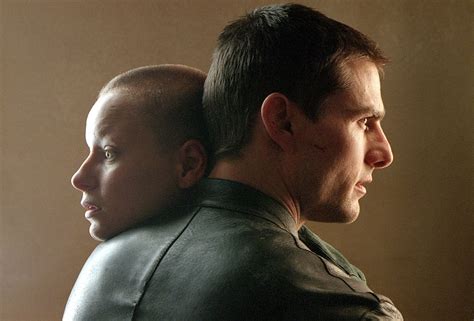
Instead of the future being an exciting entity in Minority Report, there is a sort of indifference to it, since it is already known. The world of Washington DC in 2054 is essentially a recreated mythology, with the Precogs resembling the Oracles in how they retell abstract versions of the future. But with the addition of sleek cyberpunk technology, there is an element of sophistication to this mythology; instead of god-like figures ruling over humanity, in this case, it is up to a few men to look closely at these visions and actively prevent them from happening, with a high success rate. But the use of technology is in some ways more violent than the crimes of passion it hopes to deter. If anything, the dehumanization of humanity and the bureaucratic effect it can take make it more horrifically violent than any wartime event.
Brian Massumi’s theories of preemptive violence present an interesting paradox; to prevent a horrible crime from happening, one must commit an act of violence against a person or group before they do anything criminal. The initial intentions of this paradox had good intentions, but the Machiavellian reasoning also allowed for unethical violence to be justified in the name of peace: “It goes without saying that the ‘people’ the government is ‘for’ cannot, in any of the iterations of the formula, entirely coincide with the ‘people’ the government is effectively ‘by,’” (221). In “Minority Report,” one could question why the use of force by the PreCrime Division is seemingly more violent than the crimes of passion the program is created to eliminate. In the opening scene, we are treated to the destruction of a peaceful home life torn apart not only by the wife’s infidelity, but also by PreCrime’s interference in the possibility of a murder. After the husband is arrested, we can hear the pained cries of the husband apologizing for his actions, and the wife crying out asking for forgiveness. Even though PreCrime was created to spare innocent people the grief of losing a loved one, the program arguably leaves more emotional scars on the population than before its implementation.
PreCrime’s mission is not only unethical in how it ignores the people it is supposed to protect, but it also relies on the relentless use of surveillance. Massumi touches upon the subject of history in “Perception Attack,” and how “The overall aim of force-against-force is attrition. It meets the enemy head-on and wears down his capabilities over an extensive series of frictional engagements. Its aims and means are painfully tangible,” (69). Mass surveillance constantly follows the characters of the film; it is not only present in PreCrime, but also in how the ads respond personally due to a character’s eyes. Once again, the Machiavellian reasoning does more harm than good. The bureaucracy of PreCrime means that Ann’s murder is brushed under the rug as a cold case, and Agatha is dismissed as simply having another “echo” due to how her handler’s constant surveillance frames her as a vulnerable being rather than as a human one. Due to this constant surveillance, many characters do not have the time to stop and think about what they are doing; they must simply act in the moment to stop something horrible from happening in the future. As a result of this movement, there is no time to recover, and they are ultimately made vulnerable by a system made to protect them and make society stronger.
This article was originally written for MS140 PO-01 Screening Violence, taught at Pomona College by Prof. Kevin Wynter.
 BEYOND THE FRAME
Leave a comment