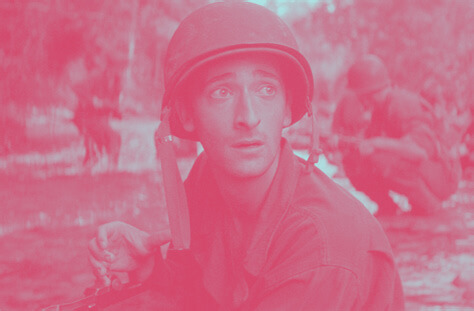
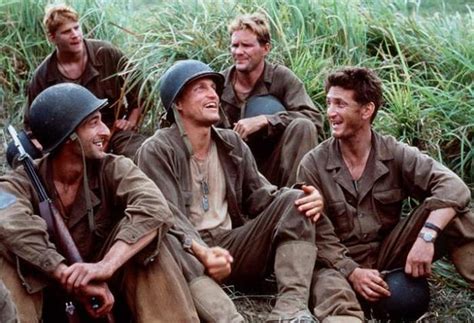
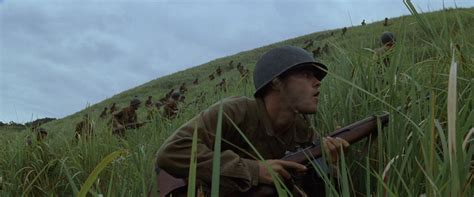
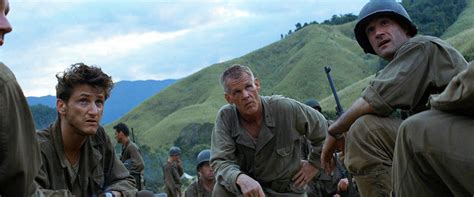
One of the most stirring images in The Thin Red Line (1998) is the shot where the camera appears to float over the grass in the Guadalcanal battlefield. After all the bloodshed and destruction, Terrence Malick’s tendency to focus on the more peaceful and philosophical shines through, not unlike how the sun shines through the jungle leaves as Witt confronts his inevitable fate. Both The Thin Red Line (1998) and Hiroshima mon amour (1959) both perfectly illustrated the power of affect, and its power to reimagine historical and traumatic events through a personal lens.
Some of the most impactful war movies for me have been ones like Dunkirk (2017), where there is emphasis placed on the individual experiences of the characters in a perilous situation, and the visceral bodily responses they incur as a result. According to Brian Massumi in his interview with Brian Evans, “Affect grasps life from the angle of its activity, its exuberance, its drive to express always more of a body’s powers of existence or potential to be, in an always irreducibly relational way, in attunement with the affordances of the outside,” (Massumi). In The Thin Red Line (1998), Witt is positioned as a dreamy protagonist who is always looking for a way to emotionally process the turmoil going on around him. The first-person POV shot of him running up to the Japanese war bunker has the viewer look through tall blades of grass as the sun peeks out behind them. There is a sense of a thin boundary in this image, with the sharp grass juxtaposed with the beautiful sky. I felt very exposed when I first saw this shot, because on one hand I felt like I was running through a field to avoid enemy fire, but on the other hand, I wanted to stay in this beautiful field, despite what was happening. I felt a similar ambivalence in the opening scene of Hiroshima mon amour (1959), where a couple was embracing as ash seemingly fell around them. This juxtaposition between beauty and horror can be seen as a survival mechanism for both Witt and the couple in the French New Wave film, since all three characters are caught between the structural violence inhibiting their worldviews and their romantic tendencies to live in the moment.
But at the same time, both films’ messages of affect are constrained and differentiated by the temporality of their events. The Thin Red Line (1998) is set over the course of a few days, whereas Hiroshima mon amour (1959) is set over the course of 24 hours. As a result, Witt’s romanticism and the couple in the latter film have different effects. For Witt, his tendency to feel every part of the war viscerally is in stark contrast to Welsh, who stamps down all his emotions to abide by the structural violence he is supposed to enact. While Witt is portrayed as the more uprighteous soldier to not ignore what’s going on around him, he also ends up dying, whereas Welsh is left to lead the next batch of soldiers to their deaths. With Hiroshima, the woman is constantly reminded of her tragic romance with an occupying soldier in France, and she feels a constant push and pull to stay in Hiroshima with her Japanese lover or to return to Nevers, the town of her torment. In the end, both lovers refer to each other by their wartorn hometowns. While all three characters want to resist the inevitability of how their pasts and presents crush them, ultimately, affect is both a comfort and a torture.
This article was originally written for MS140 PO-01 Screening Violence, taught at Pomona College by Prof. Kevin Wynter.
 BEYOND THE FRAME
Leave a comment