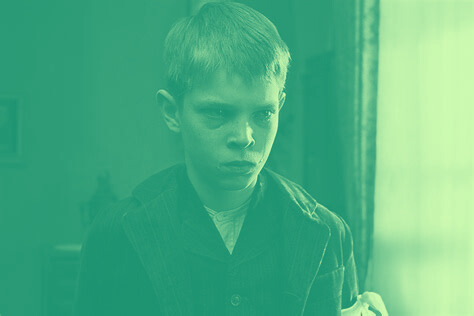
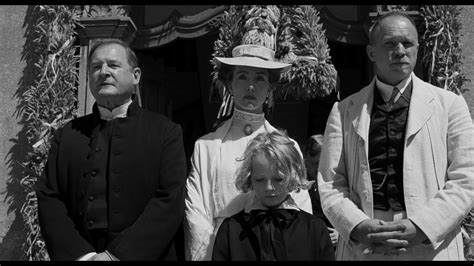
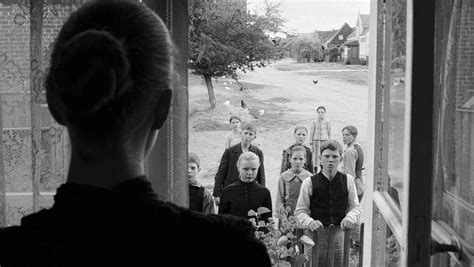
The White Ribbon stuck with me far longer than I thought it was going to. While Michael Haneke’s Funny Games (1997) was effective in making the audience feel like an active participant in the sadistic murder of a family, The White Ribbon was spine-chilling in how it made me akin to a willfully ignorant bystander. Throughout the film, I was aware that the adults were perpetrators of violence, but I was more conflicted on the role of the children. While most of them were undoubtedly victims of abuse, they were also more than willing to commit acts of violence against each other. But what Slavoj Zizek’s reading “SOS Violence” did was highlight some aspects of the film that I hadn’t considered before. Mainly, the violence we were exposed to onscreen was essentially a front for the invisible violence that in retrospect, has always been there.
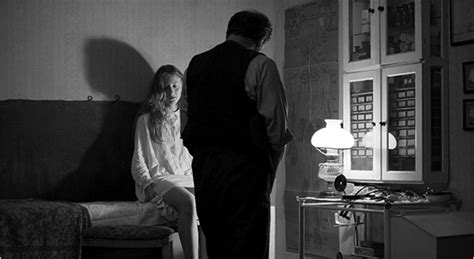
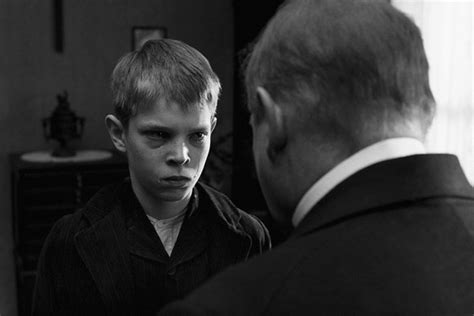
What I first noticed in the film was that when a child was beaten, the violence always happened offscreen, with the camera looking at a door of the room where the violence was taking place. The theater of the mind was left to do all the work to imagine the wounds the children would sustain afterwards. In the film, the parents and adults justify this use of violence as a form of punishment; in their minds, if they severely punish one child, they can use them as an example for the other children of what would happen to them should they disobey the rules. However, this does not really deter the children. If anything, they use violence right back towards the authorities. When the pastor is confronted at the end about the possibility of his own children being the perpetrators, he responds incredulously, like to investigate the accusations would be a mark of high treason. This ties in directly with what Zizek said about how liberal communists view radical communistic violence. In “SOS Violence,” Zizek says that while we can easily point to ideological sources of communism as the reason for acts of communist crimes, “when one draws attention to the millions who died as the result of capitalist globalisation, from the tragedy of Mexico in the sixteenth century through to the Belgian Congo holocaust a century ago, responsibility is largely denied,” (Zizek 14). Communism is essentially a capitalistic scapegoat. When we draw attention to the radical politics of communism and how its ideology is a fantasy, it is easier to paint capitalist globalization as a benevolent ideology. But to point the finger back at capitalism signals a sign of treason, and leaves the accuser alienated. For the pastor, admitting his own children were the reason for the village’s turmoil would have been a sign that his violent politics and punishments held no power over the children. Likewise, the children’s glib responses to the teacher about their involvement also signal a reluctance to admit that they were just as culpable as the adults. For them, positioning themselves as neutral gave them more power.
In some ways, The White Ribbon terrified me more than Funny Games. The veil of neutrality and moderation that was present in the former film made me more anxious than the latter film, which was upfront about how the audience was just as culpable as the sadistic Paul and Peter. The ambiguity about the children’s involvement also made the ending more terrifying. The inclination to believe the children were solely victims is to blatantly ignore all the facts that they are the inheritors of their parents’ brutality, which they will carry with them for the rest of their lives.
This article was originally written for MS140 PO-01 Screening Violence, taught at Pomona College by Prof. Kevin Wynter.
 BEYOND THE FRAME
Leave a comment