
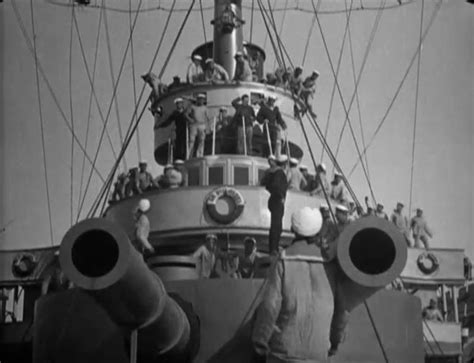
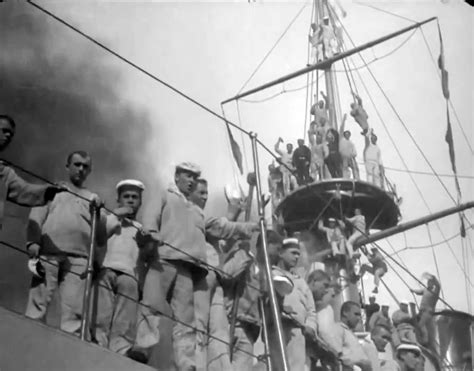
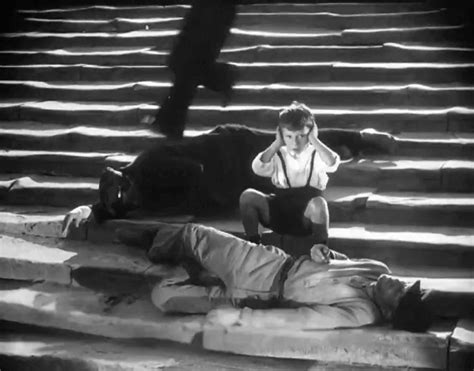
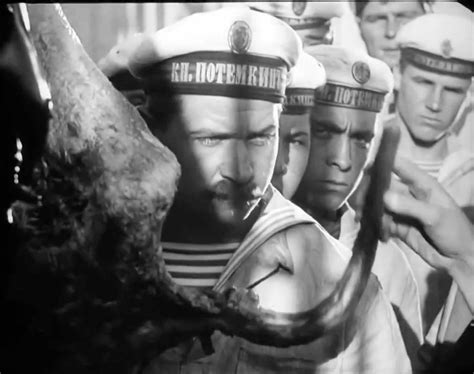
One day in 1905, a group of soldiers on the Russian naval battleship Potemkin complain about the quality of rations they are given on the ship, only to be violently suppressed by the higher-ups. As a result, a mutiny erupts, leading to the death of Vakulinchuk, a passionate supporter of the revolution in Russia. When the townspeople of Odessa celebrate the mutiny, the military show up and mercilessly shoot fleeing civilians, including women and children. Despite the prospect of battle with Tsarist ships, the remaining Potemkin sailors wave a red flag, and the Tsarist ships refuse to open fire on their comrades.
While the film clearly perpetuates Bolshevik ideology, the film can also be seen as a way to memorialize the heroic mutiny aboard the Potemkin. Through this lens, Battleship Potemkin succeeds, although I would argue the film overdoes it with symbolism in some moments. For example, during the famous Odessa Steps montage, the sequence where the grieving mother carries her dead son to the Tsar’s soldiers is very obvious in its intents to show the soldiers’ cruel nature. In addition, the film’s inclusion of “Les Marseillaise,” during the mutiny on the Potemkin mirrors the rebellion on Mars in Aelita: Queen of Mars (1927) in its glorification of mass resistance. However, I found the film to be quite effective in some moments, especially during the Odessa Steps montage. The moment where the intertitles scream “SUDDENLY…” when the white soldiers arrive scared me; the score change felt like a jump scare in a horror movie. That wasn’t the only montage that I found myself enjoying. Right before the mutiny, there are a series of shots where the resentment of the soldiers is shown through a pot of boiling water onboard the ship. Alongside shots of soldiers working, I could feel the tension rising along with the other soldiers. When the mutiny did occur, it was a great moment of catharsis that showed the top of the volcano erupting.
However, Sergei Eisenstein’s relentless uses of montage to accentuate pain and devastation were not always so critically acclaimed. For example, Roland Barthes was critical of Eisenstein’s obvious pathos, but Georges Didi-Huberman argues Barthes missed the point. For Huberman, the power of Eisenstein lay in a “narrative unit endowed with a ‘perfect legibility’: it is given to see only in a montage of differences out of which ‘obtuse meaning’ bursts forth at every moment, in every interval, as long as one accepts to become attentive to the rhythm, the very pulsation of these differences,” (Didi-Huberman 317). I agree with Didi-Huberman’s close reading; it is not just about the images themselves, but the power the images gain once they are juxtaposed with subsequent contrasting shots that give Eisenstein’s montages such pathos.
Works Cited:
Didi-Huberman, Georges, et al. “Pathos and Praxis (Eisenstein versus Barthes).” Sergei M. Eisenstein: Notes for a General History of Cinema, edited by Naum Kleiman and Antonio Somaini, Amsterdam University Press, 2016, pp. 309–22. JSTOR, http://www.jstor.org/stable/j.ctv2z6qf8v.17. Accessed 30 Jan. 2025.
This article was originally written for RUST110 PO-01 Russian and Eastern European Cinema, taught at Pomona College by Prof. Larissa Rudova.
 BEYOND THE FRAME
Leave a comment