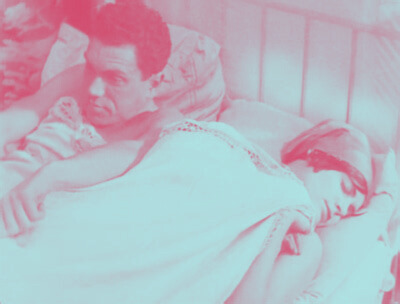
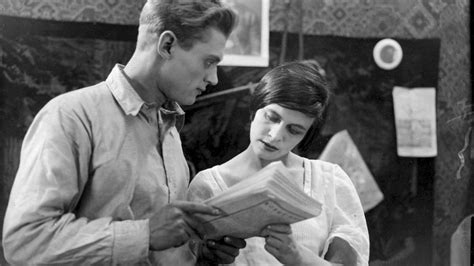
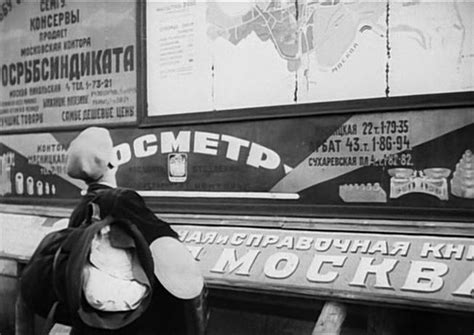
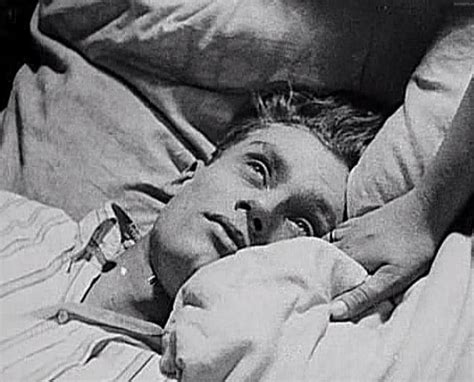
In Bed and Sofa (1927), Liuda and Kolia live a mostly happy life in Moscow, with the housewife Liuda longing for more out of life, while her husband works as a stonemason. Their usual routine is disrupted when Kolia’s friend Volodia moves into their apartment due to a housing shortage, and Volodia’s kind behavior towards Liuda leads to them having an affair. When Kolia finds out, the three live in a newly hostile environment. Ultimately, Liuda rejects the stifling presence of the two men and leaves to live on her own with her unborn child.
I was surprised at how progressive this film is with regards to the examination of gender roles. I’m generally not a fan of love triangles, but I like that this film focused less on the romance between Liuda and Volodia and more on how the resulting affair leads to relational fallout between the three characters. More importantly, the film’s focus on Liuda’s perspective gives us a rare glimpse into what we would describe in modern terms as “the female gaze,” although to say that the film wholly ascribes to it would be overly simplistic.
I believe the film’s intent was to reinforce Stalinist ideology with a feminist perspective. First, the film concerns a bourgeois couple undergoing a crisis when the woman rejects the patriarchal structure of their marriage, and the film ends with her disavowing her bourgeois lifestyle for a more independent and labor-oriented one with her unborn child. Her final words being “I’ll work—I’ll survive” to Kolia and Volodia speaks volumes; she is not just asserting her independence, but adhering to a Soviet framework of relying on work to ground one’s lifestyle. I saw Kolia and Volodia’s competitiveness over her love as a filmic representation of capitalism. Much like the debates over Russia’s cultural significance between the narrator and the Marquis in Russian Ark (2002), the internal debates in the film reflect larger conversations to be had about the nature of Russian politics and national identity. In this way, I think the film succeeds in adhering to Soviet ideology while also considering how individuals’ flaws keep them from fully acclimating to these systems.
The production design of the film was one of the most impactful parts of the movie. Liuda and Kolia’s apartment is bourgeois and full of items and decor, but it also feels suffocating and claustrophobic, which reflects Liuda’s mindset of being a trapped housewife. When Volodia enters the picture and disrupts the couple’s marriage, the items in the house correspond to Liuda’s emotions, such as the tea kettle boiling as her emotions rise up to the surface when Volodia and her husband argue over who deserve her. In the footnotes of Tarik Cyril Amar’s review of female representation in Ukranian cinema, Amar cites how the transformation of Liuda is “ambiguous,” but the evidence in the film leads me to reject this interpretation. While the lack of subtlety can be a problem for other audiences to arrive at their own conclusions, I like that the set-up of the house reflects her inner mindset, since the apartment is not just a setting, but a reflection of a woman’s inner turmoil. Even though Liuda “belongs” in the home, she does not feel at home, and that is what leads to her decision to leave at the end of the film.
Works Cited:
Amar, Tarik Cyril. “Reframing Sovietization: Sovietization with a Woman’s Face: Gender and the Social Imaginary of Sovietness in Western Ukraine.” Jahrbücher Für Geschichte Osteuropas, vol. 64, no. 3, 2016, pp. 363–90. JSTOR, http://www.jstor.org/stable/44113489. Accessed 10 Feb. 2025.

This article was originally written for RUST110 PO-01 Russian and Eastern European Cinema, taught at Pomona College by Prof. Larissa Rudova.
 BEYOND THE FRAME
Leave a comment