
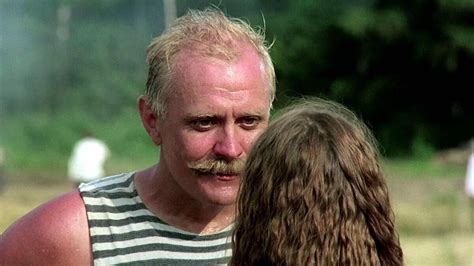
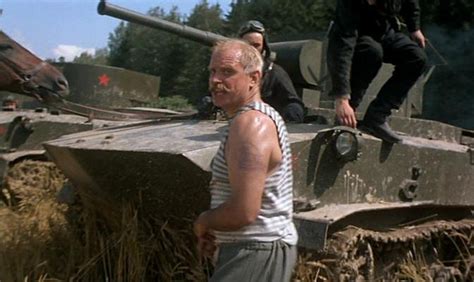
Burnt by the Sun tells the story of three generations of reckoning with Stalinism in a remote Russian village, as local celebrations of Stalin’s birthday looms over the family. The family is visited by the matriarch Masrusia’s former lover Mitia, who is now working for the secret political police and is tasked with bringing Kotov in for betraying the Soviet Union. As the young Nadia dreams of becoming a soldier of Stalinism, it becomes clear that the gorgeous summer day will end in tragedy.
One unique aspect of the film that stuck out to me long after the story concluded was the presence of a burning sun that floated through several scenes. In its first appearance, the small sun floats through the living room, harshly illuminating the door banister where the family has marked the relatives’ growth every year. When it passes by the wall filled with family portraits, the fireball smashes through the glass covering a portrait of the family, disturbing the uneasy peace. Although the large family is shown to be a consistent unit throughout the film, the sun suggests otherwise.
My interpretation of the sun’s role is that Nikita Mikhailnov is using it to symbolize the destructive influence of Stalinist ideology in modern Russia. The three generations of the Konstatinovich family are shown to have differing views regarding Russia’s socialist superiority and Stalin’s glorious status in the country. Nadia, the youngest, yearns to be a part of the pro- Stalinist Young Pioneers, even singing a song under her breath, containing lyrics such as “burnt by the sun/as the crimson tide did run,”. In contrast to Nadia’s young and optimistic view of Stalinism, which sees the “sun” as a shining force for hope and unity, Mitia and Zotov see the sun of Stalinism as more of a curse than a blessing. Both were on opposite sides of the Russian Civil War in 1917, and when they reunite in the film, Mitia has changed his allegiances from the White Army to the Red and now works for the secret police. But instead of having a stern allegiance to Stalinism, he abuses his power for his own selfish desires, as Mitia holds Zotov responsible for conscripting him into the secret police so he could have Marusia to himself. As a result, Marusia’s mental health took a severe hit, and she is now in an unequal yet loving marriage to Kotov. Instead of uniting the family in solidarity, Stalinism fractured a family and prevented any reconciliation between different ideologies.
The presence of a truck driver trying to reach his delivery address, only to be killed by Mitia at the film’s climax, shows just how brutal the Great Purge was in its brutal enforcement of Stalinism. When the driver asks a Young Pioneer leader about the address, he says that the address is faded, yet he keeps striving to find his destination up until his untimely death. The floating sun makes its return after Mitia kills himself, as his personal revenge did not bring him the satisfaction he so clearly desired. Although Stalinism was seen as a horizontally unifying force, it instead destroyed a fractured yet loving family apart.


This article was originally written for RUST110 PO-01 Russian and Eastern European Cinema, taught at Pomona College by Prof. Larissa Rudova.
 BEYOND THE FRAME
Leave a comment