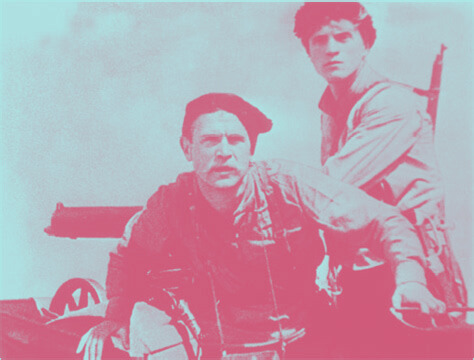
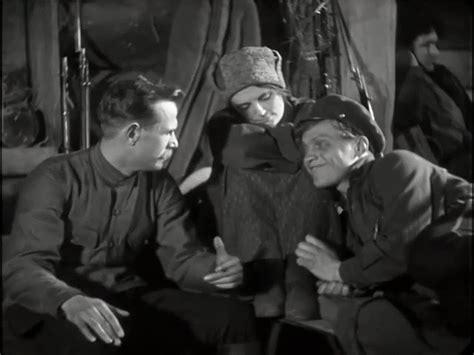
During the Russian Civil War, Vasily Chapaev organizes a ragtag band of Red Army troops in the impoverished countryside against the White Army. After forming a bond with Furmanov, a commissar from Moscow, the White Army advances against Chapaev’s forces, despite the Red Army’s proficiency with a machine gun. However, Chapaev dies in the crossfire, but the fight for communism in Russia continues.
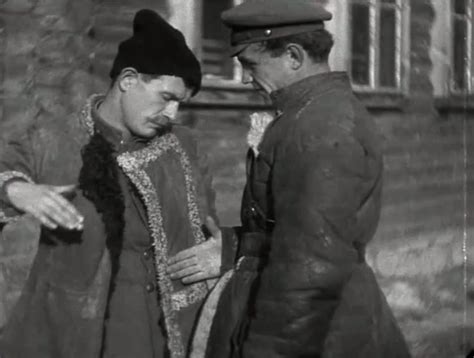
The film is definitely aiming to amplify the legend of a classic Russian military hero by adhering to collective strength and heroic sacrifice. I would say the film succeeds in this regard, because Chapaev is not portrayed as if he is a god, just a regular man with flaws who happens to be leading an army. When he finds out that some of his men have been stealing from already suffering peasants, the speech he gives is shot in a medium at a neutral angle. For a film focused on a legendary revolutionary hero, this seems to work against the picture’s intent, since he is supposed to be disciplining his men for betraying the trust of the people. Normally he would be shot with a more intimidating angle, but the Vasilyev brothers make it so that he is not physically imposing. Chapaev’s wardrobe exemplifies this; the only distinctive clothing he wears besides his uniform is a black cap on his head, and when he joins the battlefield, he dons a long black cape. This qualities give Chapaev an “everyman” feel, which is essential to portraying a revolutionary hero as an ideal for Soviet ideology.
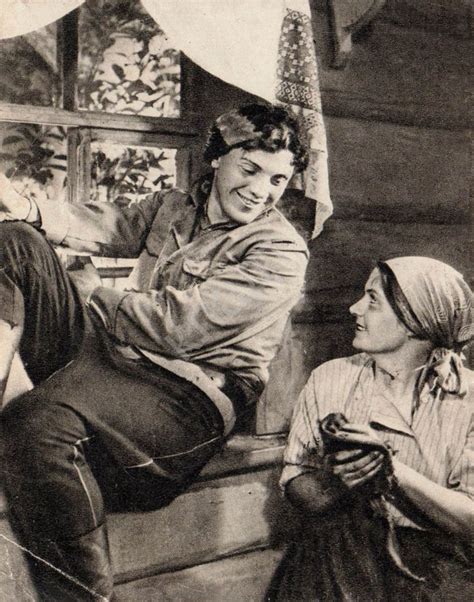
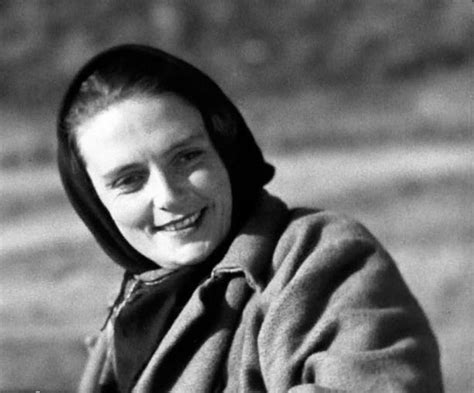
In terms of comparing this film to others we have seen in this class, there are some similarities to be made between Chapaev and Aelita: Queen of Mars (1925). I loved the character of Anna in the former film. Her proficiency with a machine gun in the battlefield was awesome in and of itself, but I also liked how her complicated relationship to the Red Army in Chapaev makes her small journey in the film stand out. Despite her dealing with sexism among the recruits, her belief in Chapaev leads her to triumph over the White Army by carrying a message to neighboring Red Army fighters for a counterattack. In a sense, Natasha from Aelita acts as a mirror character, because she is someone who fights for a system while simultaneously feeling trapped in it. In the end, both characters are able to get through to the men in their lives and play critical roles in the development of their stories.
I was curious as to what the real Chapaev was like, since the film does a great job at mysticizing this real figure. And apparently there has been a huge industry around immortalizing Chapaev through games and books. In fact, the commissar Furmanov wrote a biography about Chapaev that turned him into an overnight hero. But much like the myth of the Wild West in the United States, this mythology has a cost. Although Chapaev has come to represent Soviet ideas, an irony exists in that “Chapayev is is an archetypal ‘cowboy,’ a free spirit who supports revolution, but in his own way,” (Youngblood 227). I think it’s interesting that Chapaev was Stalin’s favorite film hero, considering how Westernized the film makes him and what cowboys have traditionally represented. It definitely seems that American cinema may have had a deeper impact on Soviet cinema than previously thought.
Works Cited:
YOUNGBLOOD, DENISE J. “Chapayev, Vasily Ivanovich.” Encyclopedia of Russian History, edited by James R. Millar, vol. 1, Macmillan Reference USA, 2004, pp. 226-227. Gale eBooks, link.gale.com/apps/doc/CX3404100225/GVRL?u=claremont_main&sid=bookmark- GVRL&xid=7822acb7. Accessed 13 Feb. 2025.
This article was originally written for RUST110 PO-01 Russian and Eastern European Cinema, taught at Pomona College by Prof. Larissa Rudova.
 BEYOND THE FRAME
Leave a comment