
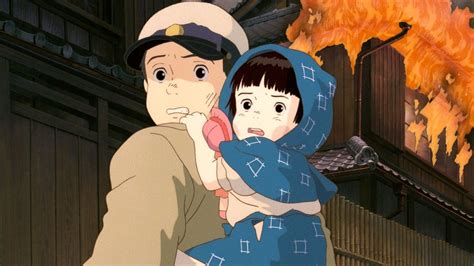
Grave of the Fireflies (1988) defines itself as a relentlessly grim film from start to end.
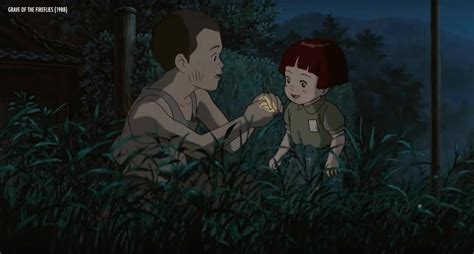
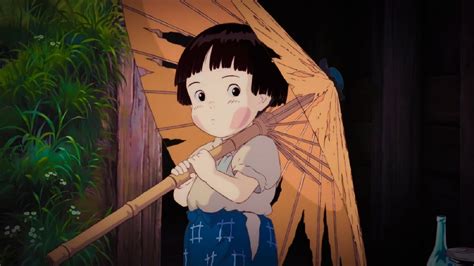
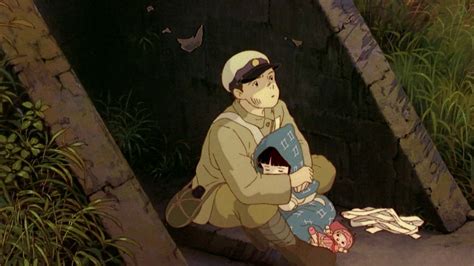
The opening scene sees siblings Seita and Setsuko run frantically through Kobe as it is firebombed, and while they make it out alive, they are nevertheless terrified. When Seita learns that their mother died during the attack, he and his sister move to an aunt’s house to seek refuge. The two make the best of their new situation by going to the beach and eating fruit drops, even though their aunt makes no efforts to hide her contempt for them eating her food without contributing to the war effort. After a long period of bullying, Seita decides to move him and Setsuko to an abandoned bomb shelter nearby, so they can continue living without their aunt hovering over them. But it soon becomes clear that this innocence is futile; Setsuko becomes gravely malnourished, and Seita’s hustling for resources reaches desperate and dubious ends. He stands by his decision to leave his aunt’s place, even as Setsuko’s health further deteriorates. In the end, Setsuko dies, and Seita passes away in a subway station at the end of the war, with the can of fruit drops thrown carelessly into the bushes.
I’d argue that despite the aunt’s behavior, Grave of the Fireflies demonstrates that realism is a more valiant approach than idealism during periods of war, since it emphasizes working with the community as opposed to preserving one’s self-esteem. Seita tries to make the best out of the dire circumstances that he and his sister are thrust into, but in the face of intense rationing and heavy firebombing, this presents a drain on his aunt’s resources. Although his aunt is far from perfect, her realist outlook is more guaranteed to result in survival than Seita’s cheery optimism. According to John J. Mearsheimer in The Great Delusion: Liberal Dreams and International Realities, liberalism flies in the face of people’s need for social connections, which can lead to a lessened chance of survival, arguing that
it [liberalism] places virtually no emphasis on the importance of fostering a sense of community and caring about fellow citizens. Instead, everyone is encouraged to pursue his own self-interest, based on the assumption that the sum of all individuals’ selfish behavior will be the common good. (Mearsheimer 107)
In the chaos of World War II, Seita’s aunt provides a rare sanctuary. Although her abrasive behavior turns Seita away, she was at least a guarantee of constant food and shelter, which was not available to Seita and Setsuko once they moved away. Once the two siblings moved out, they were left without a stable foundation from which to survive during the war, and this accelerated their demise.
One of the worst parts about war is how it upheaves the production of resources, and this entails a stricter need to work with members of the community to survive. Even though Seita does not have nefarious attentions to drain the community’s resources, his failure to realize this proves Mearsheimer’s point, and ultimately leads to the demise of him and his sister. Taken together, Grave of the Fireflies demonstrates how even though liberalism can provide freedom, it does not necessarily provide stability and unity in troubling times.
This article was originally written for POLI181 PO-01 Ghibli and Foundations of Poli Sci, taught at Pomona College by Prof. Thom Le.
 BEYOND THE FRAME
Leave a comment