
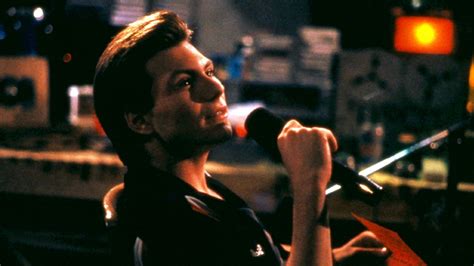
Christian Slater plays a irreverent yet reserved pirate radio host in this spunky flick that mixes free speech commentary with poignancy.
Who knew how easy it could be to make masturbating sound effects with your hands? Hard Harry does.
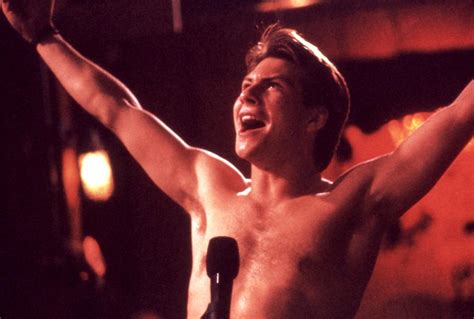
Mark Hunter is kind of like Superman. By day, he is a reclusive and antisocial teenager who rarely speaks, even though his writing indicates otherwise. However, by night, he is the irreverent, wise cracking radio host Happy Harry Hard-On (or Hard Harry for short), who perfectly captures the angst, horniness, and isolation of his classmates in his local Arizona town. Although his pirate radio inspires laughter from many of his classmates and even some of his teachers, the main authority figures of the school think otherwise. When Hard Harry’s broadcast is blamed for a student’s suicide, the school begins a crusade to shut the radio down for good. But Mark’s got other plans.
Featured on the Criterion Collection’s “90s Soundtrack Movies” playlist, Pump Up The Volume perfectly encapsulates some of the biggest cultural debates happening around that time: free speech. Hard-On Harry is unapologetically horny and rambunctious, blasting independent music that would put even the most ardent vinyl collectors to shame. But when the subject of a teen’s suicide comes up, the film pauses for a moment of sincerity. There’s nothing inherently funny about the student, who’s completely serious about his intentions. Unfortunately, Mark, who is already uncomfortable in his own skin, feels like there’s little advice he can offer under Hard Harry’s persona, so all he can say is “Maybe you’ll feel better tomorrow.”
It’s only natural that the authorities blame Hard Harry for the suicide, but the film wisely points out that the growing sense of isolation the student likely felt is shared by most of the student body. Moreover, the school places more focus on the student’s grades as an impetus for success rather than their emotional or mental wellbeing. For many students, Hard Harry is a reflection of the inner pain many of them are feeling as they trudge through the living hell that is high school. On the night of the student’s funeral, Hard Harry apologizes to the dead student for not stopping him. Although the radio host is far from perfect, he had no intention of taking it that far.
Although a common criticism is that Pump Up The Volume (1990) can get a bit preachy, one could argue it’s better than being subtle. After all, a large component of free speech debates in the 1990s was how media was largely being scapegoated for horrific things happening. Whether it was Nirvana, Marilyn Manson, NWA, or Mötley Crüe, politicians such as the Parents Music Resource Center (PMRC), led by Tipper Gore, sought to paint such groups as menaces to society, despite having the opposite effect. Such debates continue to be held today, especially as book bans have been on the rise in conservative states such as Florida and Texas. While such books don’t strike fear of causing a mass shooting, books such as GenderQueer by Maia Kobabe and All Boys Aren’t Blue by George M. Johnson have been accused by conservative politicians and advocacy groups of being pornographic, in an attempt to prohibit young students from learning about the variations in sexual orientation and gender identity.

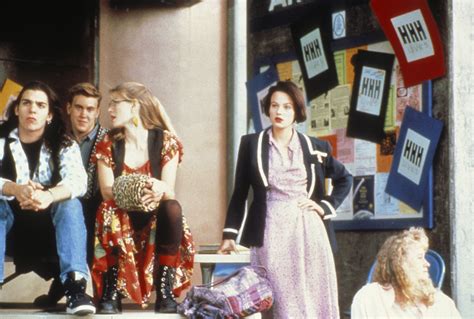
As such, it’s a nice change that Pump Up The Volume doesn’t resort to stereotypes regarding high schoolers. Anybody pretty much seems to be on the same page within the student body, which is by design. The main enemy is not the student body, but the system that prizes academic achievement above all else. While grades do matter, they’re not life and death in the grand scheme of things. What is important is how a student carries themself in the face of adversity. Instead of tuning out and going along with what life awaits you, Pump Up The Volume encourages us to question why such dehumanizing systems exist in the first place, and to do so with a knowing smile.
 BEYOND THE FRAME
Leave a comment