Akira Kurosawa pulls off a perfect Japanese adaptation of Shakespeare in this beautiful classic.
Hunters stand on rolling hills in the Japanese countryside. One finds three boars in the distance. They mount. They pursue. And soon, all three are dead.
The main conflict in Akira Kurosawa’s Ran is not political, or even dynastical. It is, however, a tale of colonialism, fatherhood, and what happens when a patriarchal figure realizes just how deep in the seven circles of Hell he has dug.
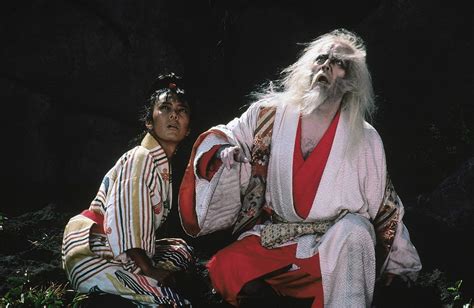
If white is the color of purity, for Lord Hiredota, it is the color of ash. Once a great feudal lord, he now seeks to have his eldest son, Taro, rule in his stead. But once Taro exiles him and his second eldest son Jiro sides with his older brother, Hiredota has nowhere left to go. He banished the one son who loved and respected him enough to speak out against him, and he deteriorates, turning into an ashen beggar with no one except his nurse and jester.
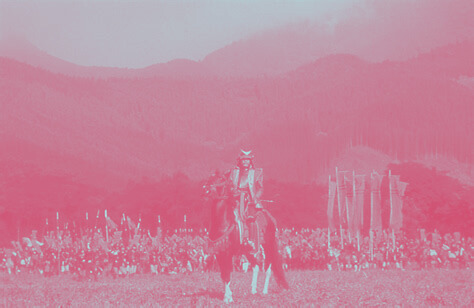
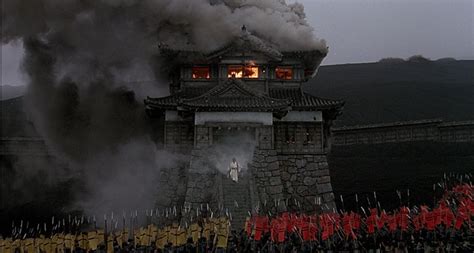
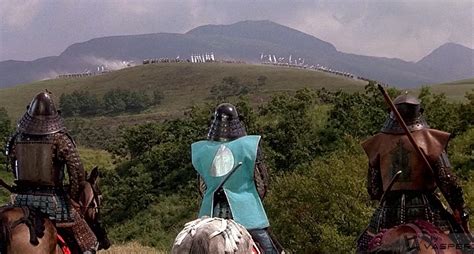
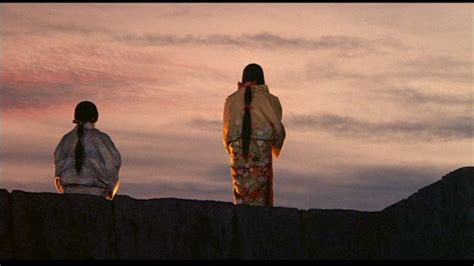
The colors in this film are simply magnificent. The three sons are color-coded so you know which forces are represented on the battlefield: the gilded yellow for Taro, the raging red for Jiro, and the serene blue for Subaro. For the disassembled patriarch, his white is every color of the spectrum absorbed into one person, until he is no longer someone who stand on his own but rather a shell of his former self. Stumbling upon the ruins of a castle he once burned to the ground, his well of memory runs dry, until all he can do is question where and who he is. The nurse he has traveled with tries to keep up with him, but eventually even he gets tired of his mad king’s rants and lashes out at him. “In a mad world, only the mad are sane.” Such is the thesis of the film.
Considering Akira Kurosawa’s humble start in prewar and postwar Japan directing topical slice-of-life films, it is only fitting that one of his most crowning achievements is a Braveheart-style masterpiece that succeeds the Mel Gibson film in every possible way. There’s the brutal battlefield scenes and castle sieges, yes, but there’s also emotion behind every shot. It’s not just a feudal legacy falling apart, but a family falling apart. When Lady Kaede’s manipulations are revealed, she proclaims she was avenging her family, who were slain by Lord Hiredota decades earlier. One can leave the theater conflicted: does Hiredota deserve forgiveness? Like a blind man on the edge of a cliff, the answer is impossible to truly find.
 BEYOND THE FRAME
Leave a comment