
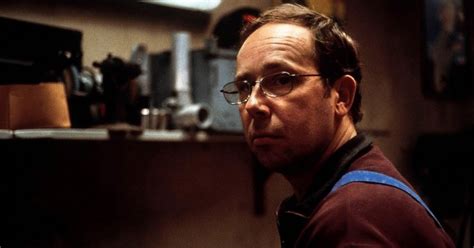
For our final screening of the semester, I was surprised. Throughout this course, I came into every screening expecting there to be sharp and cutting violence that jolts the senses, but The Son (2002) does so differently. The film’s realist tendencies undercut how sometimes the worst part of violence is not just the act itself, but rather the aftermath. Olivier’s quest to help Francis and hopefully forgive him culminates in a fight between them, but instead of the fight ending, the fight simply continues offscreen.
I found the ending to be really abrupt at first. There didn’t seem to be any satisfying conclusion to Olivier and Francis covering slabs of wood with a tarp, followed by a cut to black. But in hindsight, this creative decision works. Both Olivier and Francis are touched by death; Olivier is still in grieving over the death of his son, and Francis is still plagued by home troubles and his time in jail for theft and murder at a very young age. Although one is a victim and the other is the violator, the shot of them covering up the wood seemed to resemble, at least to me, like the two were laying a body to rest. This act also tied into the third aspect of Todd May’s third criterion for nonviolent direct confrontation. In his interview with Brad Evans, May outlines the purpose of nonviolent direct confrontation: “to display the violence of the adversary for others to see, to confront the adversary with an unflattering image of itself, and to empower the people who participate with a sense of their own dignity,” (Evans). The final confrontation in The Son is the epitome of nonviolence, both in the buildup and climax.
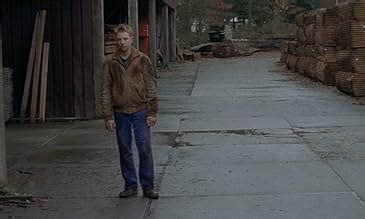
The chase between Olivier and Francis is intense in how the former’s intense grief battles with the latter’s impulse to move on. Both are in different places in their respective journeys of moving on, but the crucial point is that they can’t do so without the other. Olivier’s choking of Francis is the climax of this; it is the unflattering image of Francis that the boy has been unwilling to accept. In contrast to his childlike description of the act earlier, Francis is confronted with how his actions felt from the perspective of Olivier’s son, and by extension how Olivier felt. The ensuing moments of the two sitting next to each other, covered in dirt and panting from exhaustion, reminded me of the scene in Funny Games (1997) where Georg and Anna sit in unfathomable grief after their son is killed. At first, grief makes it seem impossible to move, even pointless. But eventually the couple does get up, and so do Olivier and Francis. Olivier is the first to do so, and when Francis returns to help him with the wood, the two reach the third stage of nonviolent direct confrontation, where the people who participate are imbued “with a sense of their own dignity.”
In hindsight, I don’t think this is a case of the two parties forgiving each other. I think it would be more accurate to say that they mutually agree to coexist alongside each other. The film abruptly ends before Olivier and Francis leave with a pile of wood covered in tarp that looks like a body, showing that neither side is willing to bury the hatchet. However, they do seem to be in the process of acknowledging the crime that connects them both, while also vowing to continue on their respective journeys.
This article was originally written for MS140 PO-01 Screening Violence, taught at Pomona College by Prof. Kevin Wynter.
 BEYOND THE FRAME
Leave a comment