
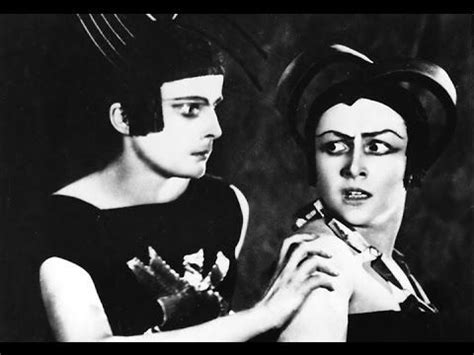
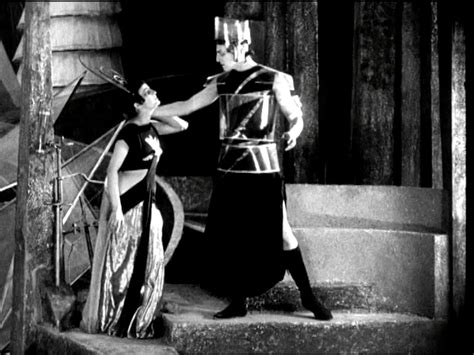
In Aelita: Queen of Mars (1926), an apparent alien signal from the planet Mars leads to Loss, a beleaguered engineer from Soviet Russia, building a spaceship so he can forget about his marital problems. After flying to Mars in a rocket ship with his friend Gusev, Loss falls in love with Aelita, the queen of Mars. When Loss, Aelita, and Gusev are arrested, Gusev incites a rebellion among the enslaved Martians, which Aelita takes advantage of to enshrine her own power. This prompts Loss to kill Aelita, come out of his daydream, and fix his relationship with Natasha.
I think that Aelita: Queen of Mars (1926) was trying to convey a message that was critical of the Soviet Union, but I don’t think the film executed this message perfectly. The anti- Soviet messages seem to become most clear in the scenes in Moscow. There is more of a bleak feel to the scenes in Russia, where the establishing shots of the city are framed like newsreels and the conflicts of the characters are of a smaller scale. Moreover, some of the characters’ conflicts are a direct result of the fallout of the Revolution; Gussev, for example, finds himself without a purpose without a rebellion to incite. Despite the newfound state socialism that supposedly makes everyone equal, there is also rampant corruption, with characters like Erlich using their power to provide friends and coworkers with food that hearkens back to memories of life before Stalin. This draws comparisons to Russian Ark (2002), where even the anti-monarchy Marquis du Custine becomes entranced by the vast amount of wealth the Russian Empire amassed. While the oligarchal monarchy is gone, it goes without saying that there are many who find the present reality of post-Revolution Russia to be incredibly disappointing.
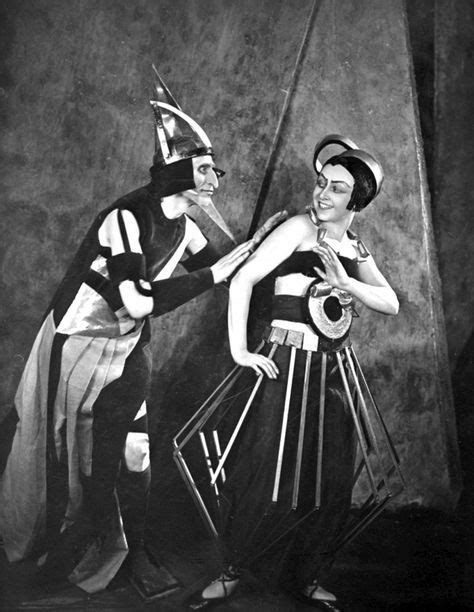
The real disappointment came at the ending, where the journey to Mars is revealed to be nothing but a dream in Loss’s head, and he ends up coming out of the dream and reconciling with Natasha. Loss’s marital conflict with Natasha was one of the most compelling parts of the film for me, and to see all the violence and love amount to a simple reconciliation was quite anticlimactic. Since Los never found out that Natasha was rejecting Erlich the whole time, the idea that Aelita is a reflection of Los’s wife in his unconscious mind does not make sense, since Aelita ends up corrupting the revolution and betraying the Martians, who are supposed to be representative of the Russian peasants during the Revolution. Marie Lathers does point out in her book Space Oddities: Women and Outer Space in Popular Film and Culture 1960-2000 that Aelita is part of the Madonna-Whore complex that is popular with depictions of women in space in early 20th century silent films, with her seductive outfit resembling a “1920s vamp: flat- chested, slim, with dark hair that is cut like a helmet around her face, a unibrow, and intense eyes,” (Lathers 161). Aelita does fit the style of a Whore to Natasha’s Madonna, to Lathers’s credit. But in Los’s rejection of Aelita for Natasha, he ends up acquiescing to the Stalinist society, where one man’s command over a Revolution resulted in a decades-long dictatorship that devastated Russia. Despite the social realism of the film’s scenes in Moscow, the fantastic element muddles the message.
Works Cited:
Marie Lathers. Space Oddities : Women and Outer Space in Popular Film and Culture, 1960- 2000. Continuum, 2010. EBSCOhost, research.ebsco.com/linkprocessor/plink?id=d7fa1f9a- dd4c-33df-8ea8-0dd456bb310a.

This article was originally written for RUST110 PO-01 Russian and Eastern European Cinema, taught at Pomona College by Prof. Larissa Rudova.
 BEYOND THE FRAME
Leave a comment