
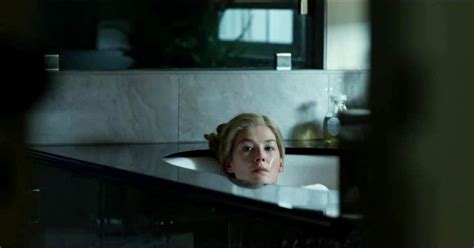
I was aware of the controversial discourse surrounding Gone Girl (2014), particularly how it approached the role of gender roles. I had heard arguments that Amy Dunne was both a feminist icon and a murderous sociopath, and after watching the film, I think it can be argued that both arguments do have some merit. But I think what was the most striking about the film was how Amy manipulated gender roles and popular perceptions of women to her advantage. Specifically, the way Amy uses pregnancy in the film is an interesting similarity to how Hitchcock frames marriage in his films.
In Hitchcock’s filmography, marriage is presented as something that is both expected and trapping. While The Lady Vanishes and North by Northwest end with happily married couples, Shadow of a Doubt and Marnie show a darker side to marriage that places the main characters in a moral bind at the end of the film. In Gone Girl, Nick and Amy’s marriage starts out happy, but gradually deteriorates over time, as the stress of moving to Missouri and Nick’s failing commitment to the marriage starts to wear down on the couple. While this would be enough to cast Nick as the prime suspect in his wife’s disappearance, pregnancy is what ultimately frames him as the bad guy: who could ever harm a pregnant woman?

Amy’s “pregnancy” turns her into a martyr-like figure in the media, and she knows this. Amy’s statement “America loves pregnant women” is quite a salient one, because pregnancy is seen as something that elevates women to a higher status in society’s mind. When Noelle announces at the vigil that Amy is pregnant, Amy goes from someone trapped in a loveless marriage to a woman whose agency was taken away from her. However, Noelle is constantly depicted as a beleaguered mother to triplets, and her pregnancy and motherhood is seen as the only defining characteristic to her character. I found this dynamic interesting; while Gone Girl portrays pregnancy and motherhood as something that can be used to elevate women’s social status, ultimately, motherhood can be just as entrapping as marriage is. At the end of the film, Amy’s pregnancy announcement feels very reminiscent of Shadow of a Doubt, where Charlie’s engagement to a detective almost feels like a cover-up for her accidental murder of her uncle, whom everyone loved. It is interesting that even though marriage and pregnancy are depicted as things to look forward to, Gone Girl makes it clear that the image of a happy marriage is a claustrophobic one, which forces both parties to put on a role that they will have to wear for the rest of their lives.
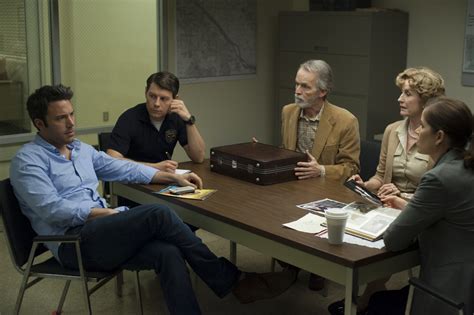
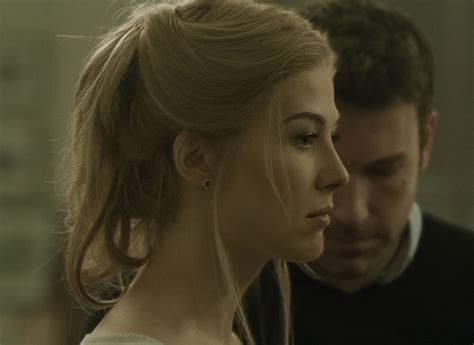
This article was originally written for LIT135 CM-01 Alfred Hitchcock, taught at Claremont McKenna College by Prof. James Morrison.
 BEYOND THE FRAME
Leave a comment