In Jordan Peele’s third feature film Nope, capitalism is the main antagonist.
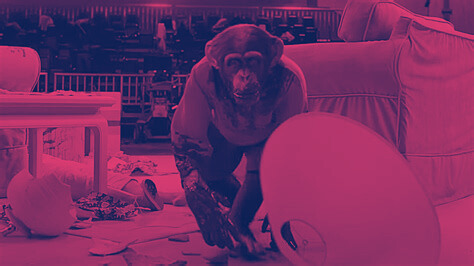
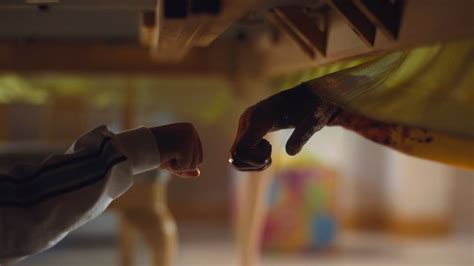
Although it is never explicitly stated as such, the apparent need to rely on exploiting people and animals to create a spectacle for profit causes the downfall of many characters. One prominent example of this in the film takes place during the main subplot, which recounts what happened on the set of “Gordy’s Home,” a fictional late-’90s sitcom starring child actor Ricky “Jupe” Park. When a set of balloons pop on set, chimpanzee Gordy attacks his costars, severely maiming several of them but leaving Jupe unharmed. After ripping off the flesh of Mary Jo Elliot, one of his co-stars, Gordy locks eyes with him before offering his fist for Jupe to bump, before the police shoot the chimpanzee. Throughout the rest of the film, Jupe, now a theme park owner, romanticizes and profits off his trauma, culminating in a grisly end at the hands of an intergalactic beast.
Much of the scene’s horror is due to how director Jordan Peele withholds the depiction of violence; Jupe’s subjective point of view means that the audience only sees hints of the violence, such as Mary Jo’s legs flailing as Gordy pounds her with his fists and the audible screams as another one of Jupe’s co-stars is mauled by the chimpanzee. The sight of one of Mary Jo’s shoes standing upright with a single spot of blood amidst the chaos abstracts the normal view of the tableau-like scene. All the while, the now-bloody chimpanzee roams freely through the set, transversing what was the background and the foreground. Although these examples are not traditional tools of horror cinema, they amplify the terror the audience experiences by implicating the audience as complicit in the spectacle while restricting the desire for us to dissociate from the chaos. Overall, the scene of Gordy’s rampage serves not only to disrupt the apparent visual background of capitalism, but also to challenge our desire for clean, yet brutal, spectacle.
The Skull and The Shoe
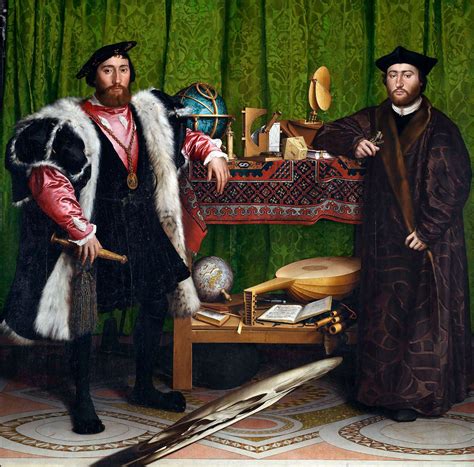
While the violence of Gordy’s rampage takes up a lot of the audience’s attention, one small object—a small blue shoe with one speck of blood standing upright—acts as an important distraction for the scene. In Lacanian psychoanalysis, it is accepted that people are trained to look at an image in a certain way, and when something comes along to interfere with that visual field, it disrupts the structure of the visuals. Lacan points this out in his chapter “Of The Gaze,” where he discusses the peculiar nature of “The Ambassadors,” the 1533 painting by Hans Holbein. The painting shows two ambassadors from Tudor England showing their vast array of artifacts, but one strange shape, an anamorphic skull that appears to fly across the canvas, causes unease. The skull acts as a “stain,” and defies the visual logic of the painting; the only way to look at the skull in a non-anamorphic way is to look at it while walking away from the painting, and after that, no one can look at the painting the same way again. Lacan adds “For the geometral space of vision—even if we include those imaginary parts in the virtual space of the mirror, of which, as you know, I have spoken at length—is perfectly reconstructible, imaginable, by a blind man,” (Lacan 86). But if a skull warps our vision and creates a negativity, what are we left with?
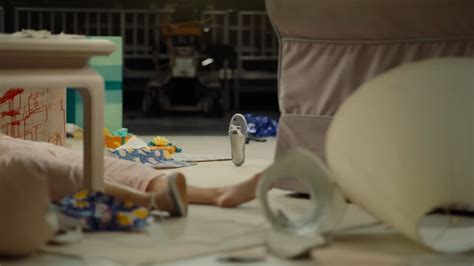
The sparsely bloody tennis shoe in Gordy’s rampage serves the same function. Around the tennis shoe, there is the destruction left behind by Gordy, with lampshades thrown on the floor, furniture torn up, and cast members lying bloody on the floor. But amidst all the chaos, Jupe—and the audience—focuses on the upright-standing shoe, seemingly defining physics. The full scene of Gordy’s rampage takes place halfway towards the movie, although the audience first becomes aware of the shoe’s existence in the film’s first shot. Already we are made aware of the shoe’s significance, and this leads us to believe that the shoe serves proof that the intergalactic beast haunting the protagonists was involved with the mauling. But instead, the alien was not involved at all: the shoe was merely standing by coincidence. Peele did this deliberately, saying that the shoe represents “a moment where we check out of trauma. And Jupe, he zones in on this little shoe, that’s Mary Jo’s shoe, that has landed in a precarious, odd situation. And this is the moment he disassociates,” (Zinski). Due to the audience’s identification with Jupe, the audience believes that the shoe must fit into the overarching plot of the film. In reality, the shoe’s existence and role in that scene was purely coincidental. Instead of allowing the negativity to exist on its own, the audience’s obsession with the shoe ultimately creates a spectacle in and of itself; we are not satisfied with a simple answer unless it fits in with the space of a broader story. Ultimately, Jupe’s obsession with capitalizing on his trauma, based on the mistaken belief that he was “chosen” by a higher power, leads to his downfall, and the audience essentially suffers the same fate through the same belief.
Another symbol is at play amidst the gore of Gordy’s rampage: Mary Jo’s legs. The male gaze has often played a seminal role in horror movies, especially when it comes to violence, as women are reduced to gory and writhing body parts as the main villain swoops in for the kill. As Laura Mulvey remarks in “Visual Pleasure and Narrative Cinema,” this provides an opening for the male character to be more active: “In contrast to woman as icon, the active male figure (the ego ideal of the identification process) demands a three-dimensional space corresponding to that of the mirror-recognition in which the alienated subject internalised his own representation of the imaginary existence,” (Mulvey 838). In horror cinema, it is a common tradition that women are among the first people killed, thereby raising the stakes for the main characters, who are often male. Violence against female victims is shown grotesquely onscreen, giving the spectator full omnipresence over what happens; everyone can see the gore and brutality of what is happening.After the female character dies, it is up to the male protagonist to finish the story. But what happens when neither the male character is placed in a precarious position? This is where Mary Jo comes in.
Objet petit a, dressed in blue velvet
Lacanian psychoanalysis focuses on the objet petit a, or the object cause of the audience’s desire. It acts as a similar role to the traditional role of the female victim in horror movies: as a form of castration. When the audience is reminded of a lack, there is a desire to overcome this castration, leading to a mission to conquer the gaze by looking at other subjects within the frame and alienating them into an object. In “Looking for the Gaze: Lacanian Film Theory and its Vicissitudes” by Todd McGowan, McGowan looks at another example of a woman, in this case Dorothy from David Lynch’s Blue Velvet, acting as the objet petit a. Dorothy is seen as a mysterious figure throughout the film, which causes the audience to want to know more about her, leading to the film’s most climactic scene, where Frank brutally sexually assaults her. Although the audience may not actually want Dorothy to be sexually assaulted, the act itself fulfills a sort of perverse satisfaction by attempting to extract Dorothy’s jouissance, her unknowable secret supposed to fill the finder with euphoria upon discovery. But when she reveals herself, naked and bruised from her attack, in broad daylight, it causes an overwhelming sense of fear: “She does not fit in the picture, which is why the spectator becomes so uncomfortable watching her naked body in the middle of a suburban neighborhood,” (McGowan 43). Despite Dorothy’s ascribed role as objet petit a, the audience is nevertheless shocked at what becomes of her body. Her bruised body reveals the trauma of the gaze; when the audience sees all of her, there is a reminder that even though the spectator did not ask for an assault, they did ask to use her as an object.
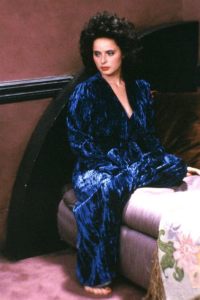
In “Nope,” the objet petit a is obscured, but the brutality still reveals the audience’s complicity. Although the audience never sees Mary Jo’s disfigured face until later in the movie, years after Gordy’s rampage, the audience gets a sense, but never the full picture, of the brutality through the positioning of the camera. Peele exploits our collective desire to witness the bloody result of Gordy’s mauling of Mary Jo. As McGowan says in his chapter “Psychoanalytic film theory,” “We cannot satisfy ourselves through having because having is precisely what destroys the desirability of the object,” (McGowan 45). Since Jupe is stuck under the table, the audience is only able to see Mary Jo’s legs as Gordy hits her, with the gruesome sound effects of the skin of her face as the chimpanzee peels it off. The audience is presented with part of the objet petit a, but there is no voyeuristic pleasure employed to make sure anyone sees the actual gore; the audience can only try its best to imagine it. This lack of seeing causes displeasure in the viewer, but we are nevertheless satisfied by the need to see Mary Jo. When we do see her later in the film, her face partially healed, that satisfaction is destroyed, and we are left with the knowledge that we, in some ways, led this to happen. Through the employment of obscuring the audience’s gaze, Peele makes it known that the gaze is not solely visual; it is a product of desire, and the bloodthirsty quest to achieve it.
Amidst the blood and gore, a visual background is provided for the scene of destruction: the sitcom set. McGowan’s focus on the gaze is not solely based around the Lacanian focus of desire, but also on the inherent pull of capitalism. McGowan defines the “capitalist gaze” as capitalism’s ability to disguise itself as a natural background to proceeding events, even when it is no longer self-sustaining. This gaze is especially present in film and TV, where people are advertised a fantasy of a life they could be living. As McGowan says, “Visual reality successfully presents itself as a background against which and in which we desire rather than as a field thoroughly colored by our desire,” (McGowan 17). When this background is seen as neutral, there is almost no need to question it, and the audience appears all the better off for not knowing the uglier side. The fantasy element of the capitalist gaze is also apparent in McGowan’s work; as he said in “Psychoanalytic film theory,” fantasy “buttresses the dominance of social authority by granting this authority a substantiality it doesn’t actually have,” (McGowan 50). In this sense, the sitcom is the perfect encapsulation of the capitalist gaze; it presents a wholesome reality where the middle class are the role models for society, and the characters in the show act as buffers for capitalism, where they obscure the more harmful parts of the gaze.
“Gordy’s Home,” the sitcom that Jupe and Gordy star in, is filmed in 1998, almost a decade after the era of Reaganite capitalism. Gordy’s rampage effectively destroys the capitalist landscape of the sitcom. Before the attack, Peele shows the set-up of the sitcom in which Gordy is in, with the audience seeing different shots of the set through the multiple sitcom cameras, almost like they are watching the show as a live audience member. But when Gordy starts his rampage, the screen cuts to black, and when color returns, the audience is in Jupe’s position, witnessing everything from the visual background that was presumed to be neutral. The positions are flipped, with the audience now seeing the dark audience seats in the background, creating a feeling of being scrutinized and observed. Although Gordy is not making a political statement with his rampage, his rampage showed how fragile capitalism is, if it all it takes to destroy it is a startled chimpanzee reacting to his own natural impulses. Even though the audience was in a position to believe they were safe by simply observing the visual background, now that they are in the background, the seemingly unbreakable veneer of capitalism is shattered, and the audience is made to be truly afraid.


Although “Nope” is a recent release, the capitalist gaze is still alive and powerful, even if it is being challenged. Despite the characters winning out in the end, the audience is left to grapple with the wreckage of what comes after. Gordy’s rampage is a prime example of this: Gordy does not kill Jupe, but Jupe’s misguided account of what he believes that day is a surrogate for how the audience feels itself to be invincible while watching horror movies. Unlike other horror movies, the horror feels incredibly personal; not only does the audience see the violence up close, but there is also the sense that the horror lies within our own addiction to spectacle, and how far we are willing to go to achieve it. Further investigations into how this theme is exemplified would be warranted, especially into how race plays a role: Peele has been credited with pioneering a type of gaze in horror that specializes the gaze of Black characters, which have traditionally been used as victims in the genre. For now, the scene of Gordy’s rampage stands out as a prominent example of the gaze. By drawing on the audience’s inclination to revel in the gaze, then contrasting that with horror, Peele reveals a terrifying truth: the audience is just as complicit in the violence as the characters.
Works Cited
Lacan, Jacques. “Of The Gaze.” The Four Fundamental Concepts of Psycho-Analysis, Routledge, London, UK, 2019, pp. 82–103.
McGowan, Todd. “Looking for the Gaze: Lacanian Film Theory and Its Vicissitudes.” Cinema Journal, vol. 42, no. 3, 2003, pp. 27–47, https://doi.org/10.1353/cj.2003.0009.
McGowan, Todd. “Psychoanalytic Film Theory.” Psychoanalytic Film Theory and the Rules of the Game, Bloomsbury, London, UK, 2015, pp. 41–57.
Mulvey, Laura. “Laura Mulvey: Visual Pleasure and Narrative Cinema.” The Routledge Reader in Gender and Performance, 2002, pp. 296–301, https://doi.org/10.4324/9780203143926- 60.
This article was originally written for MS149T PO-01 Seminar in Media Theory, taught at Pomona College by Prof. Jennifer Friedlander.
 BEYOND THE FRAME
Leave a comment