
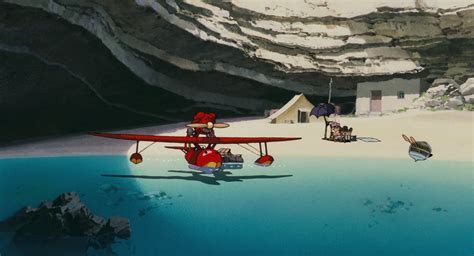
Porco Rosso (1992) is one of Studio Ghibli’s more unusual films. Despite its lighthearted tone, the titular character’s cynicism towards war and his more traditionally masculine attitude is a far cry from other male protagonists such as Jiro from The Wind Rises (2013) and Howl from Howl’s Moving Castle (2004). That being said, Porco Rosso is unique in that it focuses on the experiences of war from a soldier’s perspective, or at least from a non-human one. The film’s protagonist, Porco, was once a soldier in the war that grew so cynical from watching the conflict unfold that he turned into a pig, and is now scorned by his former countrymen for his refusal to stand with fascism. One of his closest confidants is Gina, who knew Porco when he was a human and harbors a love that he is extremely reluctant to reciprocate. Although he rebuffs her affections repeatedly to her chagrin, her love does not waver. It is this refusal to abandon Porco that guarantees his escape from the Italian Air Force at the end of the film. But even with a safe passage with Gina, are she and Porco truly free from the fascist state? I would argue Gina’s character and her relationship with Porco’s serves to represent the difficulty of separating one from the state, especially since the vast reach of the state guarantees it is nearly impossible to escape from wartime extraction.
Gina as a Lost Lenore of Pre-War Italy

From her introductory scene, the story presents Gina as a seductive figure. The audience first sees her singing to the patrons at the Hotel Adriano cocktail bar, and her command of the room manages to quell even the wildest of pirates. But while she plays the role of the seductive club singer in public, she plays a softer role in private with Porco. As shown in flashbacks, she and Porco used to fly onboard a plane called Adriano, which is also the name of her hotel where she now resides. That same hotel acts as a place of refuge for not just the pirates, but also for Porco. Whereas his residence is isolating yet tranquil, Hotel Adriano is both a place for drinks and a place to meet with one of the few companions he has from his past, who does not see him just as a ruthless bounty hunter, but also as a person.
Although it is tempting to cast Gina as the main romantic interest of the protagonist and nothing else, her position of power places her in a unique position to bargain with the state. Porco Rosso takes place in the aftermath of WWI, when fascism was taking over Italy. The state is both overt and covert with its military presence throughout the film, with citizens cheering on a military parade and secret police monitoring his and Fio’s activities through Milan. The Hotel Adriano’s location on an island renders it an intermediary position; its location off the mainland guarantees it some physical distance from the state, but the fact that it is a known harbor for state-defined pirates and criminals make it a precarious position for Gina to reside. Much like her onstage persona, Gina is someone who appears inviting, but is constantly trying to maintain her clientele from resorting to violence against each other and the state.
Charles Tilly, a social scholar who has written extensively about the state and the types of power it controls, has stated that military force is not the only tool the state uses to demonstrate its strength. He also mentions the power of bargaining as a way for states to quell domestic conflicts, and thus organize more quickly in times of war. This is especially useful when intermediaries are involved, since they can interfere with the direct rule of both capital-intensive and coercive-intensive states and produce alternative forms of indirect rule. Tilly paints a picture of how this works: “Any system of indirect rule set serious limits on the quantity of resources rulers could extract from the ambient economy. Beyond that limit, intermediaries acquired an interest in impeding extracting, even in allying themselves with ordinary people’s resistance to state demands,” (Tilly 104). Considering what kind of state Italy is in the film, as well as the Adriatic Sea, Gina’s role as an intermediary places her in a dangerous position where she must either negotiate with the state or risk losing control of her position.
Italy is both a coercive-intensive and capital-intensive state in the film. As Tilly defines the two forms of statehood, coercion-intensive entails a “conquest in which territorial lords simultaneously leagued together against common enemies and fought each other for priority within their own territory,” (143), whereas a capital-intensive state utilizes socioeconomic inequality to further the state’s own plans, (144). Gina’s stake in the war is clear. The state’s deep interest in the pirates means that once they extract their services, the state will then divide and conquer the pirate community. With Benedict Anderson’s definition of an imagined community as a “deep, horizontal comradeship” (Anderson 7) with elastic boundaries, Gina’s control over the pirates presents itself as an intense struggle to maintain the unity and wellbeing over a fractured community hunted by the state. Even though her position at the Hotel Adriano grants her some autonomy, her complaints that the pirates “treat her like furniture” (Miyazaki) points to a wider issue, in that while she does impose some indirect rule, the horizontal structure of the pirate community is always in flux, meaning that her position is never guaranteed to exact total control. That being said, her decision to save the pirates at the end of the film reaffirms her allegiance towards her clientele, and implies further loyalty to her authority. But even with this newfound authority, she is still at risk of being coopted by the state for her immense power.
When it comes to Gina’s relationship with Porco, her position as an intermediary serves as a boundary between his past as a soldier and his present as a self-serving bounty hunter. One of the objects he dislikes most about the Hotel Adriano is the photo in Gina’s office of himself as a human, indicating his desire to continue living as a pig rather than submitting to a fascist and destructive state. Gina takes a different approach to the picture; she reminds him that she was also a victim of the war, as she has lost three husbands to the ongoing conflict. Although Porco would rather be a pig than a fascist, Gina reminds him of his inner humanity, with the hope of bringing him back into a community of belonging. But does his refusal to belong necessarily equate to a positive type of freedom?
When Pigs Fly
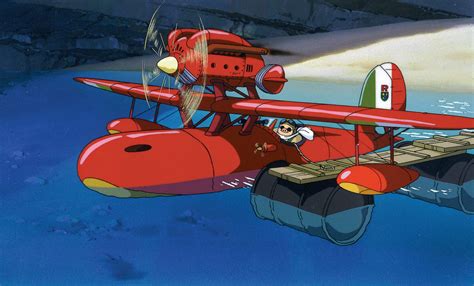
Porco’s decision at the film’s end serves as a point of exile for him. As opposed to the Hotel Adriano’s luxurious island port, Porco lives in an isolated cove for most of the film, providing him with some protection from pirates and the state. But this protection is not guaranteed, as the pirates manage to ambush him and Fio after the two leave Milan. Due to his status as a wanted man (or pig) and his location and resources, Porco’s escape to an unknown destination means that for the first time, neither his allies nor the state will know his location. This choice of living as far away from the state as possible has links to southeastern Asian tribes of Zomia, most of whom live in mountains that are incredibly hard for states to access from the lowlands. Such tribes have lifestyles that are easily adaptable to new circumstances, providing them with evolving and fluid cultures. For example, pastoral nomadism is a common practice where “Moving with their flocks and herds for most of the year, such nomads are constrained by the need for pasture but are unmatched in their ability to move quickly and over large distances,” (Scott 184). Likewise, Porco’s plane has constraints on how long it can travel and with what resources, but the pilot’s unmatched skill has the possibility of overcoming these odds. But how long Porco can evade the state without being captured is left undetermined. The film’s emphasis on the fragility of Porco’s plane means that where he is determines how he survives, and while the Zomia communities have access to the mountains, the airborne environment in which Porco thrives can be easily accessed by the state. Considering Gina’s position as a highly influential intermediary figure in a horizontal community, Porco’s relentless escapes place him on a literally different plane. Due to his lifestyle, he will always be on the run, no matter how hard he tries.
There is also a pragmatic reason for Porco’s constant running from the law. For one, while he appears indifferent to Gina’s feelings, his actions in the film indicate otherwise. Fio tells the audience in the film’s epilogue that Porco remained on the run from the Italian state for many years, but remains vague as to whether or not he and Gina ever met again, saying that it was a secret between her and Gina. The ambiguity of this ending is frustrating, considering how Porco essentially ends the film the same way he began, but this lack of closure can also provide a new opening from which to engage with alternatives of identifying oneself outside of the state. William James writes in his book Pragmatism that in a world where different intentions collide with one another, it is always important to consider whether they matter at all in the grand scheme of things. He goes on to say that “The whole function of philosophy ought to be to find out what definite difference it will make to you and me, at definite instants of our life, if this world-formula or that world-formula be the true one,” (James 32). From a pragmatic standpoint, whether or not Gina and Porco ever reunited is beside the point. What truly matters in the grand scheme of things, is that for the first time in the film, Porco is outside the reach of the state. Since Gina is an intermediary and Fio is the owner of an airplane construction company, keeping the secret of Porco’s whereabouts will guarantee the state never finds him, and his loved ones will not be hurt. No matter what differences in worldview the three characters share, they are in significantly less danger than they would be had Porco decided to stay. Ultimately, the factor that carries the most weight in determining whether or not Porco returns is how Italy’s state formation changes from fascism into an alternative mode of government.
Overall, Gina and Porco’s relationship is bittersweet but also optimistic. In an ideal world, Porco would be able to stop running away and accept Gina’s affections, and hopefully, he would become human again. But this would be ignoring the fact that the current circumstances for both Gina and Porco do not allow that. For Gina, her position as an intermediary places her in a difficult position where she has to try and negotiate with the sovereignty of the pirate community with the harsh demands of the state, who want to coopt the pirates’ services to wage more warfare. As for Porco, while his escape at the end means he will be able to protect the ones he loves, the question is raised as to how successful he will be in that endeavor. Since his plane can only fly for so long, his self-imposed exile will only last as long as it can until the state finds him, and as demonstrated in the film, the state will stop at nothing to take him down. However, there is one sliver of hope. When one looks at the situation pragmatically, whether or not Gina and Porco will ever truly get back together does not matter in the grand scheme of things. For once, Porco gets to protect the ones he loves, and Gina gets to maintain ownership of the Hotel Adriano, with the pirates indebted to her for her interference in the film’s climax. Although Italy is still in a fascist state by the end of the film, there is the possibility that it could be replaced by a democracy, and Gina and Porco will be able to reunite.



Works Cited
Anderson, Benedict R. O’G. Imagined Communities: Reflections on the Origin and Spread of
Nationalism. Revised edition, Verso, 2016.
James, William, and Eric C. Sheffield. Pragmatism – a New Name for Some Old Ways of Thinking by William James : With a Critical Introduction by Eric C. Sheffield. Myers Education Press, 2019.
Miyazaki, Hayao, director. Porco Rosso. Studio Ghibli, 1992.
Scott, James C. The Art of Not Being Governed : An Anarchist History of Upland Southeast Asia. Yale University Press, 2009.
Tilly, Charles. Coercion, Capital, and European States, AD 990-1990. B. Blackwell, 1990.
 BEYOND THE FRAME
Leave a comment