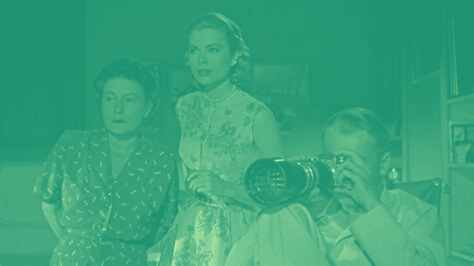
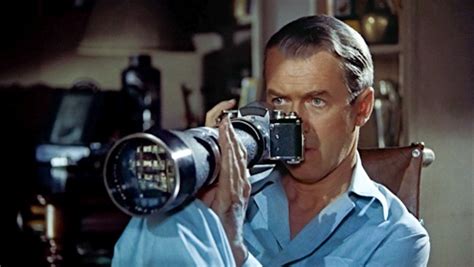
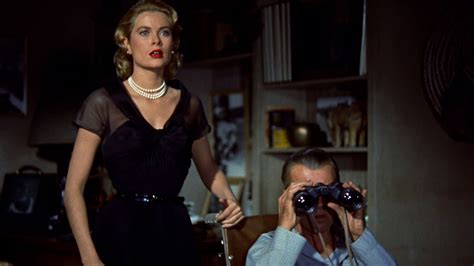
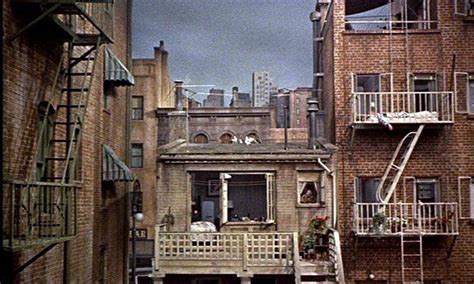
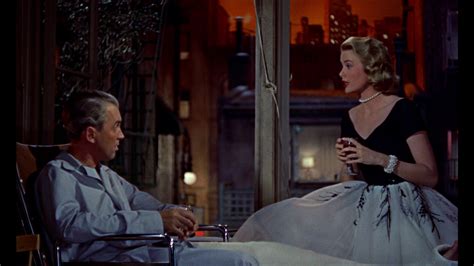
One thing I was intrigued by while watching Rear Window was the use of darkness in the film. Throughout the film, Jeffries has been spying on his neighbors to decipher what exactly happened to Thurwald’s wife, and this voyeurism mostly consists of Jeffries looking from his blandly decorated apartment to the brightly colored ones of his neighbors. But when Thurwald goes to confront Jeffries in the climax of the film, both men are shrouded in darkness. Hitchcock had used darkness before in Shadow of a Doubt, where he framed the sinister Uncle Charlie as hiding in the shadows like Dracula, waiting to swoop the young Charlie into his clutches. However, this instance of darkness seems counterintuitive considering the circumstances; after all the work that Jeffries had done to prove Thurwald was guilty, both men are denied the satisfaction of looking at each other square in the face. Upon closer inspection, I realized that the use of darkness can be seen as Hitchcock’s way of critiquing the voyeurism that he himself had pioneered.
In Rear Window, the audience identifies with Jeffries in his journey to expose Thorwald’s crimes, and for the most part, the audience feels a sense of security as we watch the windows of the protagonist’s neighbors. Voyeurism rarely focuses on the spectator’s identity; there is always the sense that what matters is what the spectator is looking at, and so there is a sense of entitlement to look, to flash a spotlight on the subject while remaining hidden in darkness. But when Thorwald stares directly into Jeffries’s camera, and indirectly at us, there is a sense of primal fear for having been discovered. Even though Jeffries felt safe within the cocoon of his apartment, not even feeling a need to turn off the lights until halfway through the movie, the truth was that Jeffries was never safe from being the object of Thorwald’s gaze.
In a sense, Thorwald’s invasion of Jeffries’s apartment inverts the two characters’ relationship. Before, Thorwald was a menacing murderer, and now he is facing off against the shadowy figure that has been watching him since the beginning. He is, as Robert Stam and Roberta Pearson put it, the equivalent of King Kong, “unchained and attacking the audience,” (Stam and Pearson, 206). Considering the anti-McCarthyist undertones of “Rear Window,” which came out during a time of heightened paranoia around the activities of one’s neighbors, it is interesting to see voyeurism be critiqued, since at the time, it was arguably encouraged in the name of “national security”. But instead, darkness subversively puts Jeffries into the position of the villain, which places the audience in an uncomfortable position of being confronted about their own voyeurism. While it can be argued that the ends justified the means, darkness provided a refuge for voyeurism to continue undeterred until it was almost too late.
This article was originally written for LIT135 CM-01 Alfred Hitchcock, taught at Claremont McKenna College by Prof. James Morrison.
 BEYOND THE FRAME
Leave a comment