
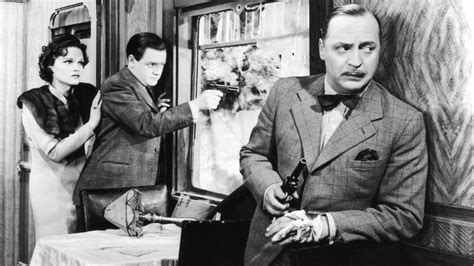
As I was watching “The Lady Vanishes,” I was struck by how integral the role of thetrain is with how it regards to the female perspective. There are numerous times throughout the film where the train itself plays as a sort of extension into Iris’s mindset, especially when people are trying to gaslight her into believing that Ms. Froy never existed. The moment where Iris stops the train is the most clear example of this, because it is where Iris herself stops the train—and the story—from continuing until she has her perspective validated. As Patrice Petro mentioned in his article on “The Lady Vanishes,” when Iris sees a sign that Ms. Froy was indeed on the train and starts panicking, “this hysteria is attributed, not to her confusion about the boundary between subject and object, self and other, but to her conviction that a real object actually exists,” (Petro 132). It is interesting that instead of having the female protagonist have a breakdown due to a failure to understand reality, Iris faints because she feels as if she is the only one who can see the reality, while no one else can.
It is interesting that the train also serves to masculinize the female perspective, especially when it is challenged. Petro cites how “The temporality of the train ride…also initiates a kind of rhythm that provides for Iris’s entry into an earlier psychic realm, a realm of undifferentiated sexuality and temporality,” (131). With this undifferentiated temporal realm, it increases the need for Iris to continue with her search for Ms. Froy, since any stop of the train’s movement could mean peril for Ms. Froy and a further disregard for Iris’s mental state. Therefore, the physical movement of the train acts to stabilize Iris’s authority, and her perspective in extension.
Her quest to find Ms. Froy is one of steadfast determination, despite most of the people on the train dismissing her. While the film is centered on a female perspective, it should be noted that for Iris to succeed, she must adhere to a traditionally “masculine” register of linear time, and therefore cold, hard logic to convince Gilbert and others that she is telling the truth. Even though the train serves to reaffirm Iris’s reality, it is also through a “male” lens that Iris achieves her goal.
This article was originally written for LIT135 CM-01 Alfred Hitchcock, taught at Claremont McKenna College by Prof. James Morrison.
 BEYOND THE FRAME
Leave a comment