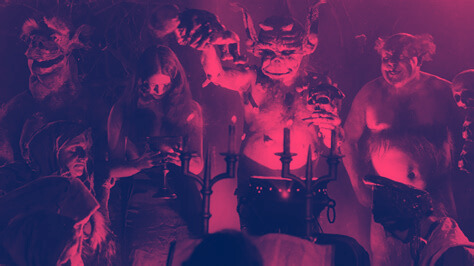
Although this silent horror film from Denmark posts an interesting connection between the past and present, the lackluster pacing and strange academic approach hinders the haunting potential.
When it comes to silent films, there’s nothing better than a silent horror film. Classics such as The Cabinet of Dr. Caligari (1920) and Broken Blossoms (1919) don’t see the lack of sound as a hindrance, but rather as an opportunity to amplify the horror. When Cesare invades a victim’s home in Caligari, the confusing environment and the thrilling score place you right in the scenery. In the tragic climax of Broken Blossoms, Lillian Gish’s desperate performance makes you deathly afraid of the abusive father while tearing up at the girl’s plight. Although it was born out of a relatively new medium, silent horror films are classics precisely because of how they use the environment to their advantage. However, Häxan (1922) doesn’t quite live up to the potential.
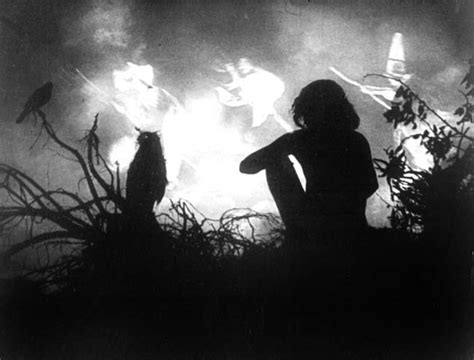
Don’t get me wrong–the film has it all. There’s witches, a physical manifestation of Satan, an anti-clerical sentiment, plus there’s excellent performers from the main cast. But there’s something stiff about the whole thing. Split into seven vignettes, Häxan acts as a documentary of the history of witchcraft in the Middle Ages, and how it translates towards the treatment of the mentally ill in the early 20th century. The first act is nothing more than a live-action slideshow, where a medieval photo is shown while Benjamin Christensen pokes a stick at some of the key points. It’s important to provide context, but in a horror film, it’s also crucial that you keep the audience on the edge of your seat. In this case, I was incentivized to go to sleep.
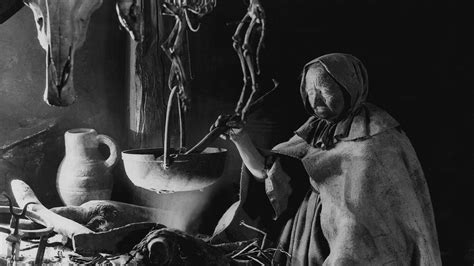
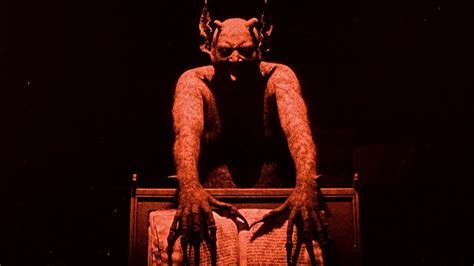
Häxan (1922) also makes it difficult to ascertain the tone. The Criterion Collection website characterizes the film as being full of “gallows humor,” and the film’s score adds to this. One scene has a witch (pictured above) pick out the bones of a thief’s fingers, but the music has a jovial tone to it that makes you feel as though you’re watching a twisted Monty Python skit. As witches are tortured and nuns are possessed, it’s difficult to make sense of how the film wants you to react.
This issue is further exacerbated towards the end, where it tries to connect the history of witchcraft to the then-present issue of treating mentally ill patients. Instead of “burning them at the stake,” per se, we should treat them as if they are human beings. This was undoubtedly fair for its day, and the film does comment on how unexplainable phenomena is often attributed to some otherworldly force. But I feel like this film could have been improved had they incorporated this element to the very end. Considering how the mentally ill have been demonized in horror, this could have been a very refreshing take, and the film would have aged even better.
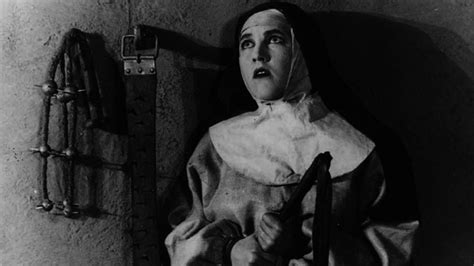
I will say that one of the things this film does well is comment on the absurdity of the clerical order. Although the witches are “evil,” they’re nothing compared to the clergy, who embody the seven deadly sins. In one scene, a nun tries to seduce a gluttonous clergy, who only turns out to be more perverted than she could have imagined. When Martha the Weaver is captured by the clergy on being suspected of witchcraft, she is bound and tortured until she confesses, with close-up shots predicting the heartbreaking emotionality of The Passion of Joan of Arc (1928). Meanwhile, the clergy laugh and gorge all they want, as witches burn and people suffer.
The visuals in this film are also quite innovative for the times. Benjamin Christensen thanks his art director in the opening titles of the movie, and it’s clear to see why. Everything feels like it was taken from historical research, transporting the audience back into a time they’ve never ventured before. Add in the supernatural elements of the Satanic Sabbath, and you’ve got something that both makes sense and doesn’t in all the right way. Like Adam Scovell reported for BBC, “it’s almost as if those old carved wood images detailing witchcraft and heretical punishment of yore have been momentarily brought to life,” (Scovell).
There are a few shots that stick out to me. When a witch who was cavorting with Satan has been enchanted, she tries grabbing at coins that have been scattered at her feet. However, visual effects have the coins reverse away from her grasp, so she must keep searching. There’s also the shot of Martha the Weaver giving birth to the offspring of Satan. Instead of normal human babies, through a process of practical effects, they look straight out of Jim Henson’s workshop.
I do appreciate how this film was ahead of its time, especially for silent films. But I think the film’s academic approach to the history of witchcraft runs too contradictory to its intention to frighten and shock the audience. As much of this film had going for it in terms of visuals and performance, its message didn’t quite meet the moment.
Works Cited:
Scovell, Adam. “Why Documentary Horror Häxan Still Terrifies, a Century On.” BBC News, BBC, 29 Sept. 2022, http://www.bbc.com/culture/article/20220906-why-documentary-horror-haxan-still-terrifies-a-century-on.
 BEYOND THE FRAME
Leave a comment