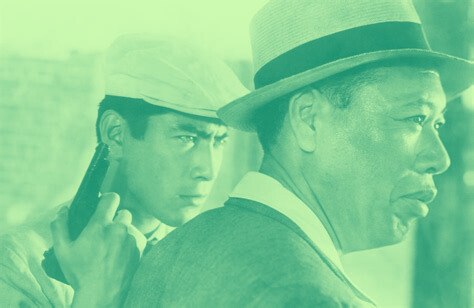
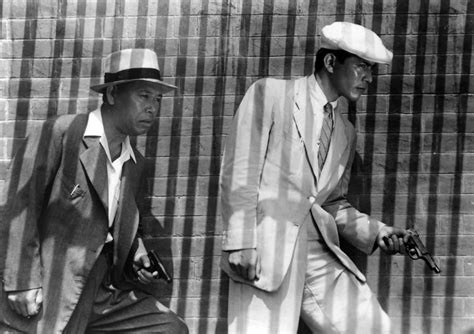
One man’s quest for a missing gun turns into an introspective journey on the plight of postwar Japanese veterans in this venerable Kurosawa picture.
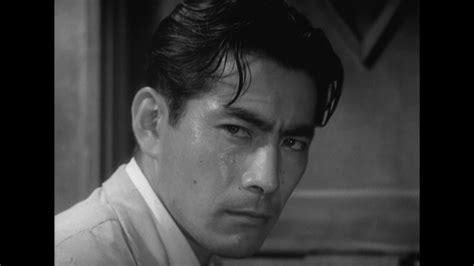
On his way home after a session at the gun range, Detective Murakami finds himself the victim of a pickpocket. But the thief doesn’t steal a couple of coins, but a Colt pistol that the police gave to the novice detective. Desperate to regain the weapon, Murakami is paired up with veteran Detective Sato on a series of cases that push the amateur detective’s mind to the brink. Along the way, he questions how different he is from the criminal he is pursuing.
Akira Kurosawa’s career spans most of the 20th century, but I would argue his postwar films are some of the best. This one can be categorized as the director’s take on film noir, which took off in Hollywood after WWII as a reflection of the paranoia and fear that was gripping the US. Meanwhile, Japan was struggling in a different way. Once the dictatorship was overthrown and Japan was demilitarized, thousands of men who had participated in the war were angry at how they had been abandoned. When we first meet Murakami, he is not only sleep-deprived after an all-night stake out, but he’s also stressed from the heat and his lackluster marksmanship. His gun being stolen represents not just the loss of government property, but his loss of power amidst uncertain times.
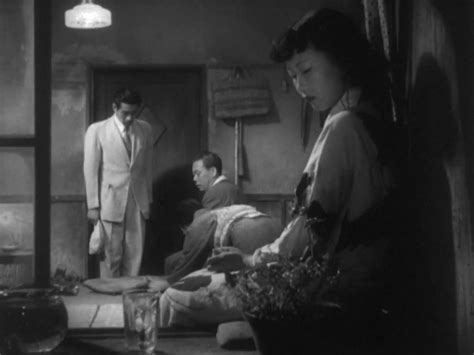
There’s a spellbinding montage that goes on for several minutes as Murakami dresses himself as an impoverished man and tours the more desolate sides of Tokyo. He’s trying to find an illicit arms dealer who may have access to his gun, but all his searching does is remind him of how separate he is from other people. He’s constantly paranoid, looking around when nobody looks him in the eyes. He’s well fed, even though everyone else is skinny and malnourished. Finally, he gives up. While it does slow the pace down, it does contribute to the four-act structure commonly used in Japanese stories.
Kishōtenketsu is characterized by four acts: kiku, the establishment of the setting and characters, shōku, development in the plot, tenku, the twist or reversals, and kekku, the conclusion and denouement. Unlike Western stories, which is split into three acts that more or less combine the shōku and tenku together, Kishōtenketsu means there is more time spent on the development of the plot rather than the twist. It can make for a slower experience, but I found this worked really well for the unconventional detective story that Stray Dog (1948) is.
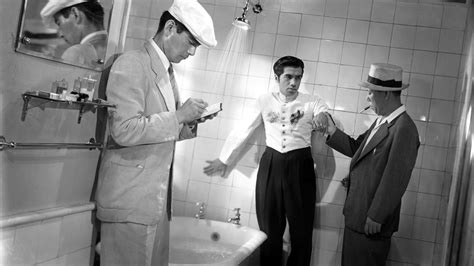
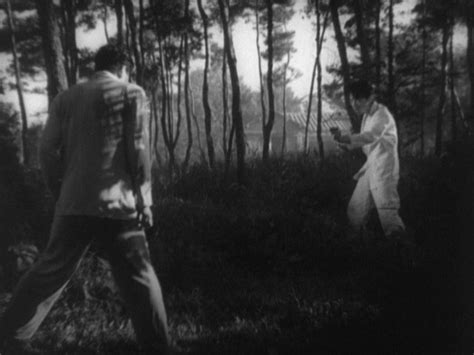
As Murakami pursues the elusive thief who possesses his Colt, he realizes that he shares some striking similarities with the man he is pursuing. They were both in the army, and they both struggled with the heightened emotionality that comes from fighting in WWII. In a way, the title Stray Dog refers to both the criminal and the detective. Once the army was gone, the only difference between them was how they chose to pursue their futures. For Murakami, he decided to continue serving Tokyo’s best interests. For the criminal, he chose to take his anger from the world out on the world, regardless of who got hurt.
This is the sentiment that Sato, the detective played by veteran Japanese actor and Kurosawa affiliate Takashi Shimura, embodies. As an older veteran, he doesn’t see any difference between one criminal and the next. Compared to Murakami’s more manic approach to solving the overarching mystery, Sato is cool and collected, channeling a form of Sam Spade in The Maltese Falcon (1941). But his black-and-white view of the world directly clashes with that of the younger Murakami, whose own views towards criminality are empathetic. As he wanders through Tokyo’s streets, he gets the sense that although criminals are a different kind of people than he is, he also can’t help but feel a bit of sympathy for those he is charged with arresting for crimes.
Ultimately, this is what makes Stray Dog (1948) a pinnacle of film noir. No character is portrayed as a stock character. There are no femme fatales, no perverted men, at the end of the day there are just people trying to survive in a country that has gone through a drastic number of changes in a very short amount of time. Although Kurosawa does try to assert some morality through the character of Sato, he also leaves room to dispute that need. Sato does have morals, but he comes from a different, somewhat more comfortable generation. Murakami comes from one where socioeconomic differences are so stark that one can’t help but rage against the world a little, even though it might mean expressing sympathy towards those who might not deserve it.
 BEYOND THE FRAME
Leave a comment