
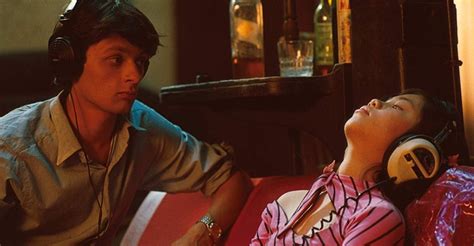
As part of Roger Durling’s Vital Cinema series at the SBIFF Riviera Theater, the 4K restoration displays all of Jean-Jacques Beineix’s Diva (1982) in its postpunk glory, even if the cinema du look is in some ways a product of its time.
Diva (1982) begins place at an opera house. In the heart of Paris, mysterious opera singer Cynthia Hawkins enraptures the audience with her astounding voice, causing one boy in the audience to cry. This boy is Jules, a young postman who has been following Cynthia’s career for years. Unbeknownst to the rest of the concert attendees, Jules records Cynthia’s vocals under his coat, starting off a rapidly escalating chain of events.
Prior to Jean-Jacques Beineix’s debut feature film, French cinema had been focused on a realist and naturalist look. While films such as Breathless (1960) and Cleo from 5 to 7 (1962) focused on a subjective perspective, the daily facets of life in France remained intact. There weren’t any stylistic choices that made the colors pop out, that turned ordinary structures into museums of culture. This is what Diva does. Instead of solely focusing on the story, Beineix turns the entire film into an aesthetic feast, thus pioneering the cinéma du look movement.
French film scholar Guy Austin characterizes the movement as something defined “not by any collective ideology but rather by a technical mastery of the medium, a cinephile tendency to cite from other films, and a spectacular visual style (le look),” (Austin 119). Instead of a devotion to realism, cinéma du look filmmakers like Beineix decided to augment their films by imbuing them with bright colors and postmodernist reference to other hallmarks of cinema. Two other notable filmmakers who belong in this movement are Luc Besson and Leós Carax, known for La Femme Nikita (1990) and Les Amants du Pont-Neuf (1991).
But as Roger Durling was preceding this presentation of Diva last night as part of his Vital Cinema series, he gave some insightful pretext. He saw Diva when he was living in Paris in his twenties, and he fell in love with this film so much he saw it thirty more times. Apparently the film had been lambasted by French critics who saw it as possessing more style over substance, but that didn’t matter to Durling. He was simply so entranced. And I can see why.
Diva‘s greatest strength is its perspective on young people and their relation to media. Jules’s fascination with Cynthia Hawkins goes beyond just his love for her music, but for his admiration of her never releasing a record. However, that doesn’t stop him from illegally recording Cynthia without her consent at her concert. But he’s not doing this so he can sell it on the street and make money. He just wants to hear her voice again. That singular voice, which entranced him so deeply.
But in another part of Paris, another tape is causing chaos. When a métro train pulls into the station, sex worker Nadia stumbles out of the station before getting stabbed by a corrupt cop in pursuit. However, she quickly slips her own tape into Jules’s motorbike before dying. It’s a startling and deeply tragic scene, not only for what is revealed to be inside the tape later but for what this means for the rest of the sex workers in Paris.
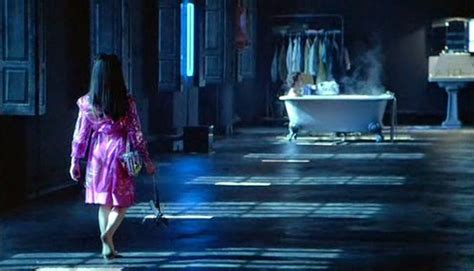
Through these two tapes, both wanted by the authorities for reasons artistic and expository, Jules goes on the run. He’s interestingly a protagonist in two very different movies. As Austin points out, the film has “the culturally ‘low’ thriller plot (Nadia’s tape) meet[s] the culturally ‘high’ opera tape (Cynthia’s tape),” (121). This synthesis of two distinct genres makes for a film that frames itself as a youth-oriented spectacle. All Jules wants to do is listen to Cynthia Hawkins and hang out in his highly stylized loft refashioned from a garage. Instead, he is caught by a tidal wave that threatens to swallow him up.
This image crops up a number of times throughout the film. At the loft occupied by two bohemians by the names of Gorodish and Alba, the former is spotted sitting completely still as he completes a large and complex puzzle. The puzzle’s a deep blue, complementing the obsidian black of the loft. But when Gorodish places the final piece of the puzzle, the picture reveals a white bird about to be engulfed in a towering tsunami. This could very well be the thesis of the film; despite the young generation’s need for hope and vitality, crushing forces of police corruption and corporate forces threaten the authenticity this generation craves.
Roger Durling cited how one core tenet of cinéma du look was a general distrust of authority, especially that of the police. In fact, Nadia’s tape reveals police involvement in a vice ring that goes all the way up to the top, including one of the figures that is chasing Jules. Jules associates with sex workers, but he treats them like people, not as objects. Nadia’s tape is filled with vitriol towards those in power; her references to the guillotine harken back to the French Revolution, where the elites were executed for their vast wealth and exploitation of those below. But if Nadia’s tape is recovered, all hope for justice is lost.
Something similar occurs with Cynthia. Jules’s tape was only meant for his consumption, but when two Vietnamese officials chase after the postman to sell the tape for money, thus exploiting the opera singer, Cynthia will lose all agency and ownership over her work. She will no longer be a singer, but a commodity.
Despite the bright colors and stylized nature of the film, Diva is a feature about the fluidity and cynicism of youth. The film might resemble an advertisement, but it’s actually a rallying cry for authenticity and agency in a time where consumerism was rising. Ultimately, everybody wants attention and money, but through different methods that rely on different systems of power. Here the question is not about how we should sell, but if we should sell at all.


Works Cited:
Austin, Guy. “The Cinéma du look and fantasy films,” Contemporary French Cinema. Manchester University Press. 1996. 119-121.
 BEYOND THE FRAME
Leave a comment