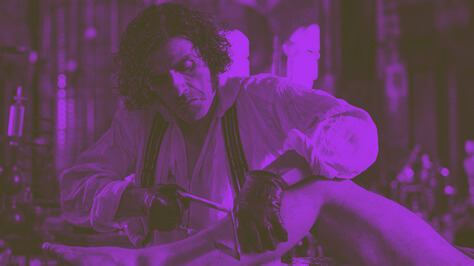
Today, I went to the Cinema Society screening of Frankenstein (2025), followed by a Q&A with director Guillermo del Toro and actor Jacob Elordi, who plays The Creature. It was an insanely cool experience. Roger Durling began the screening with a statement of “Welcome to church!” It certainly felt like it, with a packed crowd who stood out in the sun for 45 minutes to see a man we hold in the highest esteem.
Despite having seen Frankenstein twice until this point, it felt like I was seeing it anew. The Q&A revealed even more layers that I hadn’t even considered before.
Forgiveness and Humanity
One of the most important things that del Toro discussed was the circularity of the film. It starts with the Captain Anderson standing with his back to the rising sun, obsessed with reaching the North Pole at the cost of his men. When we are introduced to Victor, we see him as a man who is absolutely certain at all times, whereas the Creature is reactive. If the Creature is loved, he loves you back. If the Creature is hated, he hates you back and wants to hurt you. The conflict between these two men reaches its end when they learn to go with grace, and “forgive themselves into humanity.”
At first, I was a bit stumped why the Creature would forgive him. I mean, Victor put him through hell, and the Creature hadn’t heard his maker tell his story. Where would the empathy come from? But then I thought back to the line where the Creature roars “The miracle isn’t that I speak. The miracle is that you would ever listen!” In the end, Victor listens. He understands how deeply he went wrong when he abandoned raising the Creature as his own son. All the Creature wanted was to be understood. When Victor apologized and asked for forgiveness, that was him acknowledging the Creature was human. Not an “it,” but his son.
The Creature repeats this act of forgiveness once again when he liberates the sailors from their ice-encrusted ship. At the start, he responded to their gunfire with death and crushed bones. They were still resistant to him when he left the room at the end of the film, but once Captain Anderson stood up for him, they backed down and let him off. In return for the captain’s kindness in allowing him to tell his story, he frees the boat.
The main obstacle for the Creature wasn’t Victor, but himself. In fact, both the main characters have themselves as their main obstacle. But even when they’re far apart, they leave an indelible handprint on the other. Victor’s vision of the Dark Angel changes from a seemingly benevolent figure to a skull, symbolizing his realization of how he has embodied death. The Creature, similarly, goes from seeing the world through a pure black-and-white lens towards seeing that he is deserving of a companion, and thus of love, despite where he came from. It’s this development that both characters are able to understand where they fell short, and encourage each other to keep going with love.
The Colors
During the Q&A, Roger Durling brought up how del Toro “color-coded the heck out of this film.” Del Toro took him up on that offer, and did so beautifully in a way that only he could.
One of my favorite parts about Frankenstein was the ornate production design, especially that of the costumes. The costumes were so swoon-worthy that it made sense that Guillermo del Toro dominated the conversation with it. He paid special attention to Elizabeth’s clothes, and how they represented a sort of bridge between Frankenstein and the Creature.
Mia Goth plays both Elizabeth Harlander and Victor’s mother Claire, which, Freudian implications aside (I know that’s a big ask!) is intricately woven into the clothes. First, there’s the veil, which del Toro said served as a relic of memory. Victor only remembered his mother as a veil, because that’s what she wore constantly when she was alive. He’s only able to see Elizabeth through the veil of his memory, where she is someone to console him, rather than as a foil. As charming as he can be, she is not fooled.
Instead, Elizabeth takes off her veil to the Creature, who is nearly naked when she first encounters him. Del Toro noted that she is the only character to ever wear purple in the film, creating a connection between her bonnet and the Creature’s pearlescent skin. Both she and the Creature have a fascination with living things, as shown through the color green. Elizabeth wears a number of green dresses that mimic an insect, and the Creature’s first scene outside of Victor’s lab is in the lush green forests of Scotland. Finally, when Elizabeth dies in the Creature’s arms, she wears a wedding dress with bandage-like sleeves that resemble his own when he was made. It’s no wonder that Elizabeth dies smiling in his arms; she felt a kinship with him that went beyond words.
Dammit, Kate Hawley. You better win that fucking Oscar®.
Jacob Fucking Elordi
I don’t know what happened with me, but I immediately started blushing when Jacob Elordi arrived at the Q&A. I didn’t even know he was coming before they announced him. But after witnessing his performance as the Creature once again, I think the blushing was only natural.
Del Toro said during the Q&A that he wanted a Creature with “pure, innocent eyes,” and Elordi was certainly the right man. Elordi cited the Creature’s deep connection to animals, from elk to rats to crows as evidence of the character’s purity of conscience. It was clear throughout the whole session Elordi deeply understood the Creature’s psychology, especially when he mentioned the help he had in crafting the character, from the talented prosthetics team to the vocal coach who helped him craft his character’s signature voice. That’s the sign of a great actor. He’s proud of his craft, but he acknowledges those who helped in that process. He’s not in it for the ego; he’s in it for the art.
Elordi didn’t talk as much as del Toro did throughout the Q&A, but the creative partnership was so genuine you could mistake them for father and son. They bounced off of each other very well, especially when it came to telling stories about what it was like to work on the film. It was clear they both poured their hearts into the film, even though one of them has been working on this film on and off for 50 years of his career and the other was a last-minute replacement that ended up being the best choice for the role.
I believe this role could be the one that turns Jacob Elordi into a modern-day icon. He’s not the boy from The Kissing Booth series anymore. (Thank God.) He’s a creature.
What do I think about Frankenstein now?
I love it even more now, if that’s even possible.
Del Toro could talk his mouth off for the rest of his life about this film. All his passion came through in the Q&A. You could tell he read Mary Shelley’s book like the Bible, because that book was his Bible, especially since he’s a lapsed Catholic. For all the complaints about the film not being totally faithful to the original source material, it should be acknowledged that the book was written 200 years ago, and while there’s no way the film could live up to it, you can acknowledge it for being a beautiful work of art that captured the novel’s spirit.
This film is a huge thematic lasagna, in that in trying to uncover one layer, you uncover another and another. It’s like you’re assembling your own creature of themes. One thing about del Toro is that he is never one to shy away from the details. In fact, the intricacy of each detail, from the clothing to the colors to the writing to the original story, makes up a unique canvas that could only be this film.
I’m a little bit saddened that most audiences will be watching this on Netflix on their laptops, which does not do the film justice in any way shape or form. But maybe it will have its own KPop Demon Hunters moment where it becomes so big for Netflix it has its own extended theatrical release. Fingers crossed it happens. Until then, I’ll settle for purchasing the physical release in a few months so I can own it forever. Assuming my DVD player is still working then. It better be.
 BEYOND THE FRAME
Leave a comment