The father and son duo who crafted this story deserve a special award for creating one of the most accurate depictions of high school ever.
In an interview he conducted a few weeks ago, Quentin Tarantino said, besides shitting on Paul Dano’s stellar name, that The Hunger Games was a borderline ripoff of Battle Royale (2000). As a YA dystopian fiction lover (especially those from the 2000s), I was offended. But then I saw this film and wondered: yeah, maybe he has a point.
For the record, I’m not saying Suzanne Collins plagiarized her bestselling novels off this film. But I get where he’s coming from. Battle Royale, after all, takes place in an alternate history where a sovereign nation (Japan, in this case), has devolved into an authoritarian regime where each year a new class of students is randomly selected into a gladiatorial battle to the death.
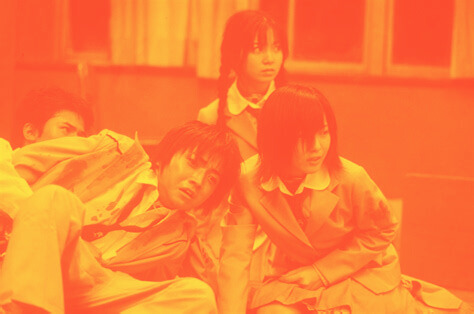
However, unlike the clear systemic allegories of The Hunger Games, Kenji Fukasaku’s film focuses more on how the dynamics of high school relationships translate extremely well in a battlefield. As soon as 48 teenagers are plunged into a mysterious wilderness with weapons, food, and a ticking clock, it’s not just survival of the fittest, but survival of the social.
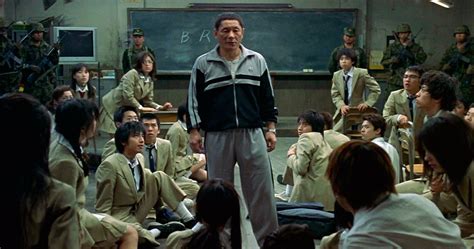
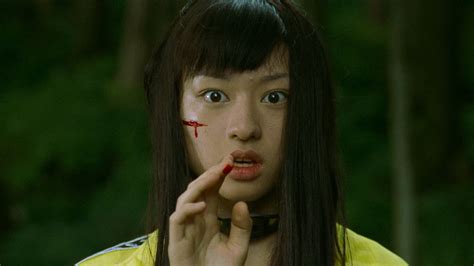
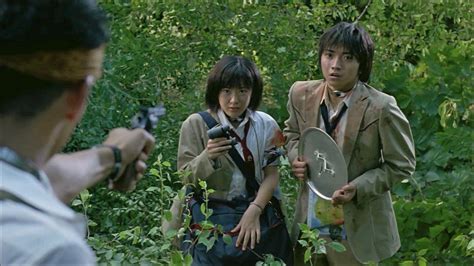
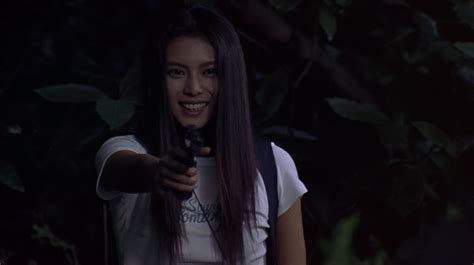
There’s Shuya Nanahara, who was recently made an orphan after his father killed himself. He quickly takes Noriko, a loner classmate, under his wing, and the two wander through the island looking for supplies and some semblance of security. But they’re not alone. There’s Mitsuko, a terrifying mean girl with a skill at wielding a scythe. There’s Kazuo Kiriyama, a “transfer student” with a hideous haircut and a more heinous love of violence. Then there’s Kitano, the students’ former schoolteacher who is now their master of pain.
I found myself enjoying this film a lot more than I thought I would. It also crystallized for me why I love YA dystopian fiction so much. It’s not just the fantasy of taking down a mysterious totalitarian government while falling in love with a blandly attractive guy and becoming a symbol of a revolution. It’s also a reflection of how disillusioned you can get with how the rest of the world categorizes you. One moment, you’re having fun with your friends on the bus on the way to a field trip. The next, you’re in an environment where you’re at the bottom of the food chain, and the only thing you can do is make do with what you’ve got and make friends with those who are on the same level as you are.
As you journey through the island with Shuya and Noriko, you start to uncover the different kinds of cliques that are on varying levels of self-destruction. Right as the game starts, you see several students eliminate themselves through suicide, sparing them the pain. Cliques reform themselves, as a smart group of students huddle up in an abandoned building to try and find a way out of the arena, and a band of girls find shelter in a lighthouse and refuse to play into the games. The latter group intrigued me quite a bit. They at first seem like a safe haven, but as the scene continues, cracks start showing, and then it becomes clear that while they are trying to play it safe with the other groups, they are not as stable as they think they are. In Battle Royale, traveling in groups is no guarantee of safety. Sometimes, going at it alone might seem like the best solution.
Noriko is a great example. She’s got a couple of friends, but she seems like the person who needs protecting, not the one who protects others. But early in the film, we see Noriko’s friendly relationship with Kitano when they were just student and teacher. As they chat, you see a different side to Kitano, and Noriko becomes someone entirely different than what you first expect. She’s at the bottom of the food chain, but being at the bottom can give you new perspectives on people you seldom see. That’s what gives her the edge. She sees Kitano as not some invulnerable monster, but as someone who’s just as much a victim as the other students in the cruel regime.
I fell in love with YA dystopian fiction because of the political allegories, but now I’m starting to recognize that this subgenre also does well at capturing just how disillusioning high school can be. High school seems like the first steps towards becoming an adult until you realize the honeymoon phase is extremely temporary. Dystopian fiction also sees how interpersonal relationships can be just as destructive as political systems, if not more so. When you’re a young person, having people you can count on can be a lifesaver. You’re not only socializing, but surviving.
FURTHER THOUGHTS
- Mitsuko could stab me in the back 49 times and I’d thank her.
- Kazuo’s hair is a crime against decency.
- I feel like this film and Shutter Island (2011) have a lot in common. People killing each other on an island, you know?
 BEYOND THE FRAME
Leave a comment