
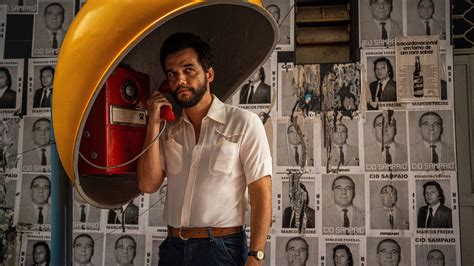
Wagner Moura proves himself as one of the finest actors working today in this subversive and darkly comedic take on the 1970s Brazilian dictatorship crackdown.
When we open on Kleber Mendonça Filho’s The Secret Agent (2025), we see photos of 1970s Brazil, featuring people smiling, drinking, and having a merry time. There’s a line of text that describes the decade as a “period of great mischief.” With a wonderfully 70s needle drop, you might enter this film with a big wide smile on your face. It isn’t until you see the first dead body covered in cardboard that you realize this is going to be something different.
Wagner Moura plays Armando Solimões, a Brazilian professor living as a political refugee who has moved back to his hometown of Recife to be closer to his family. His in-laws are worried about his safety, but Armando plays it cool, saying he’s only there for his son. He finds a tight-knit community in his new apartment building, which consists of tenants who are political refugees like him, led by the anarco-communist Dona Sebastiana. Soon, it seems like Armando has everything settled. Until two hitmen are assigned to take him out.
Right from the get-go, The Secret Agent doesn’t hesitate to tell you this isn’t going to be your daddy’s neo-noir. Granted, there’s a fair amount of gore and some playing with secret identities, but there’s also a lot of magical realism that’s integral in Latin American stories of intergenerational trauma amidst colonialism. We get our first glimpse as a human leg is graphically pulled out of a shark’s stomach. You think its significance will end as it is dumped in the river by corrupt cops. But then it washes up onshore and gains a second life, as it bursts through a red-light district and starts kicking people right in the middle of fornication. When the leg’s ass-kicking is reported in the newspaper, the characters barely pay it any mind. The world has already gone to shit.
Anyways, Armando is already finding himself in a fucked up fairy tale of his own. He’s trying to negotiate his own way to live out a semi-peaceful life in Recife, but the fact he has to negotiate means he is no longer welcome. Filho makes great use of split-diopter shots to warp the space around all the characters. When Fernando is drawing the poster for Jaws in his room, he can sense his grandfather’s looming presence behind him. When the police inspect Armando’s car at a gas station, Armando is in turn inspecting the policeman’s gaze. It’s paranoia heaped onto paranoia–even when there’s no active espionage, people are always spying, looking for a reason to reveal something. It’s not just the clothing and music that are used to foreground the story’s setting, it’s the way the camera moves that lets you in on what each character is feeling.
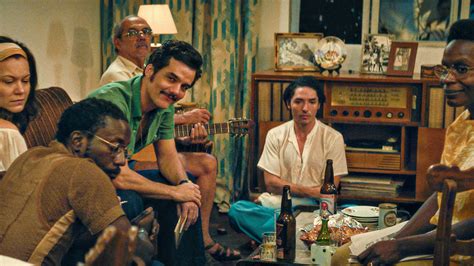
Paired with this paranoia is the quiet desperation of a father trying to reconnect with his son. It would be tempting to compare this film to I’m Still Here (2024), another Oscar contender about life under the Brazilian dictatorship. But while the family aspect is outlined clearly in I’m Still Here, the family ties are more strenuous in The Secret Agent. We get hints that a loving family used to exist, but since the narrative is nonlinear, all we get are fractured memories. You can see this imprinted in Wagner Moura’s every expression. When he looks at his son, you see him looking for something else–a reassurance that he came to the right place. We rarely see Armando’s deceased wife Fátima, but when we see her we get a profound impression that reminds us of who Armando is trying to be. More importantly, Armando feels split inside himself. He’s always trying to play someone else when he’s out in public, and when he’s finally allowed to be vulnerable, you can see him take a big gulp of air. While he thinks he’s found a sanctuary, you just know he’s teetering on the edge of oblivion.
But really, the only way to truly appreciate The Secret Agent is through its use of symbolism. The leg found in the shark’s stomach is not just a regular site. It’s the truth of the film staring at you in the face. Hidden in the stomach of a much feared predator starring in 1977’s quintessential summer blockbuster is evidence that a life was taken. It’s only natural that a shark is attracted to blood. But it’s the mystery of how the shark ended up eating the leg that keeps you awake. I couldn’t sleep after I watched the film because the film kept entering into my dream. And that’s what’s so genius about the film. At first it feels realistic, but then you realize the film is not so and then it gets you thinking about how many things we take for granted as normal in our world shouldn’t be so. What we take for oxygen might actually be cyanide, only we’re ingesting it over time until it kills us.


FURTHER THOUGHTS
- It’s insane to me that Wagner Moura played fucking Death in Puss in Boots: The Last Wish. The man is simply a chameleon. He’s going to be right up there with Oscar Isaac and Pedro Pascal as Latino actors who simply kill it every fucking time they’re onscreen.
- I want to be living in Dona Sebastiana’s apartment building when I move out. Only with no political persecution.
- Apparently there was actually a murder case in Australia in the 1930s involving a shark arm being found in a human leg. I learned about it via Buzzfeed Unsolved, and I couldn’t stop thinking about it throughout this entire goddamned film.
 BEYOND THE FRAME
Leave a comment