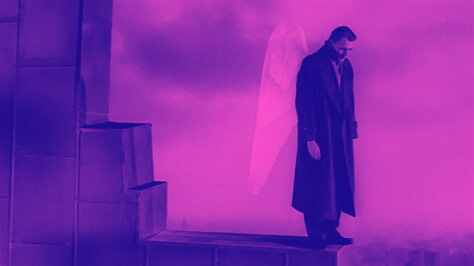
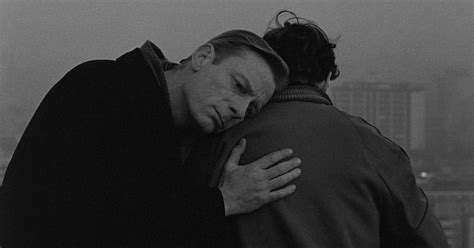
This awe-inspiring classic from Wim Wenders captures not just the city of Berlin, but the entire world, at a critical time.
Fuuuuuuuuuuuuuuuuck.
It’s been a while since I started a review like that, but it’s impossible not to have that word come out of your mouth after finishing Wings of Desire (1987), one of the most original and philosophical films to come out of the 20th century. After how busy the Santa Barbara International Film Festival was, part of me wanted to watch something spiritual. But it’s kind of hard to nail down what a spiritual film means. Does it have to be religious? Not necessarily. What about existential? Probably, but most of the time those movies just bum the fuck out of me. Does it have to be realistic? Actually, the less realistic, the better.
I found all of this and more in this film.
Damiel and Cassiel are two angels in Berlin who hover and survey the residents, observing their alienation without intervening. At a car shop downtown, the two angels report their findings, with Cassiel focusing on the most morbid, with Damiel focusing on the smaller, yet more mundane things. Since the two are invisible, they are content to sit in one model car amongst an aisle of them as people gaze on them from the window, sparked by a desire for something greater than themselves, yet never actually fulfilling that.
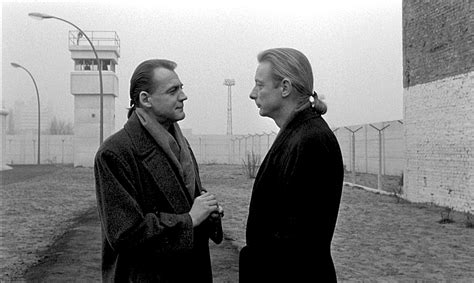
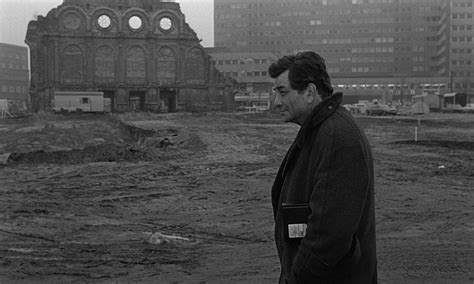
The period of the Berlin Wall has always fascinated me, but I’ve never understood why until I saw this. I was fascinated with the Weimar Republic for similar reasons two summers ago. It seems like such a revolutionary period, but one that’s always filled with extreme uncertainty and fear. However, while the Weimar Republic was for a brief decade, the Berlin Wall was up for half a century. It defined an entire generation who grew up between the fall of Hitler and the fall of the Soviet Union. Sandwiched in between these two authoritarian regimes, people on the West side of the wall were searching for meaning everywhere they found it, but they had little recourse to pursue it. As long as the wall was there, they were disconnected, both from the past and the future.
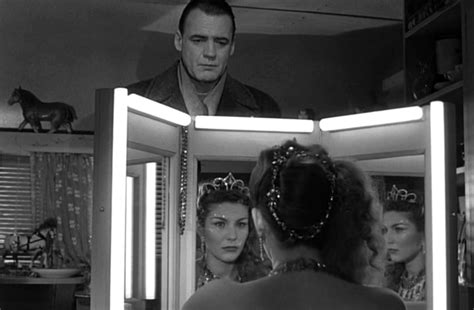
When I think of Wings of Desire, I see it as a reimagining of It’s a Wonderful Life (1946) but from Clarence’s perspective. There’s an angel, trying to find some way to achieve a higher status than he’s already at, seeing another lost soul struggling to put one foot in front of the other. Instead of Jimmy Stewart, it’s Marion, a French trapeze artist whose first appearance as an angel piques Damiel’s interest. I was at first worried it would be a voyeuristic relationship á la Vertigo, but I was so glad it wasn’t. It’s not that there aren’t shades of it. But the close-ups of Marion and Damiel’s faces make it appear as though they are speaking directly to us, as if they’re staring into our souls. Whether it’s possible to astral project yourself out of a screen and into the viewer has yet to be scientifically proven, but I think Wim Wenders may have found a way.
Marion and Damiel share relatively few scenes together, but they are everywhere in Berlin. Marion travels with a circus that is on its last legs, and she’s facing the possibility of returning once more to uncertainty. Damiel is tired of living a purely spiritual existence, and wants to exist concretely, experiencing mortal colors and pain alongside everyone else. They’re looking for shades of who they want to be, whether it’s at Nick Cave and the Bad Seeds concerts or on a pit of sand next to the Berlin Wall. Even if the romance is fairly easy to follow, it’s hard not to root for them, because I think we’re all ultimately looking for that in a partner. Someone who’s willing to “take the plunge” along with us.
I was thinking of Possession (1981) deeply throughout this film. It’s one of my favorite films I saw last year, and it also seems to be the diametric opposite of this one. Whereas Possession told the story of paranoia and the fallout of the nuclear family amidst Cold War espionage, Wings of Desire is about reconciling that paranoia and alienation and finding meaning even in the most faded circumstances. While the streets of Berlin are black-and-white in Wings of Desire, they are that way because we view them through the eyes of the angels, who see the entirety of time and therefore see 1987 Berlin as just another space and time. However, when we switch to the humans, colors pop out at us like fireworks. Compared to how Possession made Berlin look like a war zone, the Berlin of Wings of Desire is more ethereal, still alienated, but full of possibility.
I had no idea this film is the one that would make my week. It’s really hard to find a film that reaffirms your faith in humanity, but it’s still astounding to me that this was made in the 1980s. When I first saw a poster for this film, I thought it was French and made in the 1940s or 50s. This is a German-French co-production, but still. I had no idea people were making films like this in the 1980s. I always associated 1980s with the rise of the blockbuster, nylon stockings, big fucking hair and Ronald Reagan. Two things are for certain: I need to watch more 1980s films. And Wim Wenders is a mad genius.
FURTHER THOUGHTS
- Nothing fucks harder than a good German public library.
- The aimlessness associated with the circus life also reminded me of Federico Fellini’s La Strada.
- Somebody needed to cut off those manbuns off the angels. They were far too distracting.
 BEYOND THE FRAME
Leave a comment