In his first entry in his trilogy on faith and family, Ingmar Bergman chronicles a family’s disintegration as a loved one struggles with mental illness.
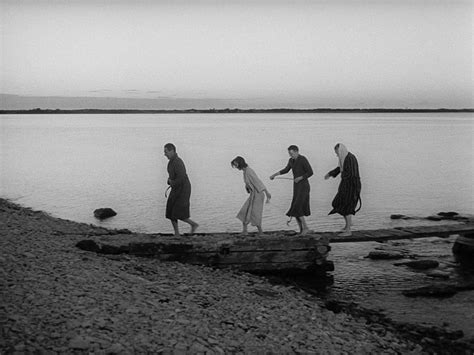
From the opening shots of Through A Glass Darkly (1961), we see a family on the brink. We start with ocean water, calm and serene, before a family wades through the water to crawl onto a dock.
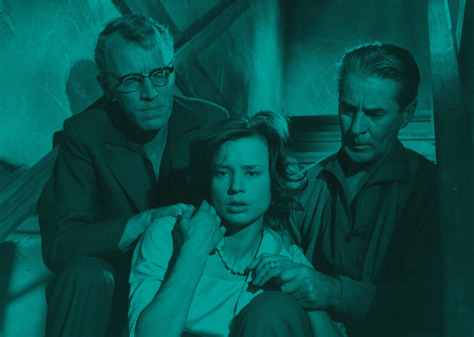
There’s David, who’s recently returned from Netherlands and is trying to finish his book. There’s Minus, the son who feels neglected. Martin is the son in-law who’s a licensed doctor. Importantly, there’s Karin, who we will soon find out teeters on the brink between reality and mental illness.
Ingmar Bergman sparked my curiosity a long time ago, but it was only amplified when I learned that Bergman and legendary Italian filmmaker Federico Fellini were close admirers and at one point planning on filming something together. Alas, that film was never made. But it’s clear from watching Through A Glass Darkly that the two shared very common interests. There’s the portrait of an artist at conflict with the rest of society, a disintegrating family unit, and the sense that whatever higher power that be is not going to come and save us.
The film starts out with the family unit acting as if the structure was preordained. The children are happy their father is home, but they’re clearly hurt when David announces he’s to return to traveling for a conference to Yugoslavia a month later. Martin is most hurt by this, saying that he wishes he could talk to his father, and later goes on rants about how women are disgusting to him. Karin tries to smooth things over as a mediator, but it soon becomes clear she is not the stable maternal figure this family needs. In fact, she is its victim.
Karin has moments of lucidity, but she lives in a constant state of anxiety over her condition. Facts of her illness are kept from her, with David and Martin talking about it behind her back, hoping to keep her away from the worst of it. But on some level, she already knows there’s little hope. It gets even worse when she impulsively rummages through her father’s desk and finds that he’s been using her condition as an inspiration for his latest novel. It’s not just the relevation she’s never going to get better that hits the hardest, but the fact that he’s using her like a muse instead of a person.
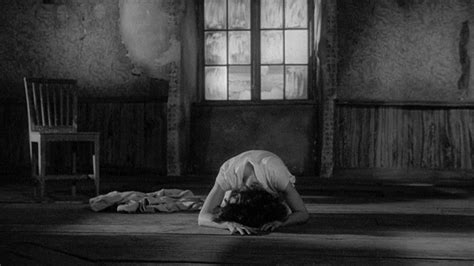
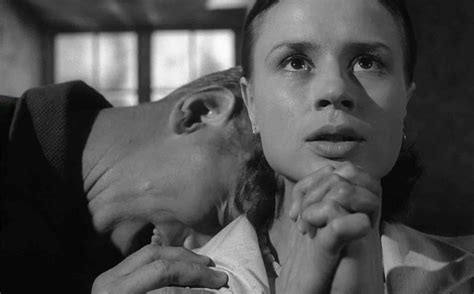
Amidst this chaos, Karin desperately craves agency. She wants stability and reassurance, but she nevertheless is forced to reckon with her newfound status as the family “problem.” Sven Nykvist’s stunning black-and-white cinematography adds to this disheveled mental landscape. The family may be on vacation, but they are not having a pleasant time. There’s moments of levity, but there’s always hints at something more painful hiding under the surface. Karin might put on a happy face when she’s with her brother and father, but she can only be truly herself when she’s alone in a room, praying to a god that exists only in her mind. Waiting behind a door is someone there to save her. Yet there’s no guarantee, and that’s what scares her.
I have a weird relationship with bleak films, but the one reason I keep coming back to them is that as an annoyingly persistent optimist, I find that bleak films can often be refreshing. In a world where everyone is so focused on appearing positive and pleasing to everyone, it’s nice to experience catharsis in films that just allow you to wallow. Mental illness and religion can be quite a hefty mix to put into a film, but Bergman allows just enough ambiguity to fester to allow audiences to draw their own conclusions about Karin and her family. I’ll probably be thinking about for the rest of the week.
I rented this as part of a Criterion Collection DVD trilogy about Bergman’s faith trilogy, which includes Winter Light (1962) and The Silence (1963). I’m planning on watching the rest of the trilogy later this week, so keep out for a review on those.

FURTHER THOUGHTS
- After only knowing Max Von Sydow for his roles as the Three-Eyed Raven in Game of Thrones and Lor San Tekka in The Force Awakens, I was quite impressed with his performance here as Martin. That man was a powerhouse!
- I don’t know if there’s some incestuous subtext in here (there probably is, and I’m just ignoring it out of self-preservation), but I wonder if kissing your sibling on lips was a sign of affection in mid-20th century Sweden.
- I was getting some Yellow Wallpaper vibes from Karin’s room.
 BEYOND THE FRAME
Leave a comment