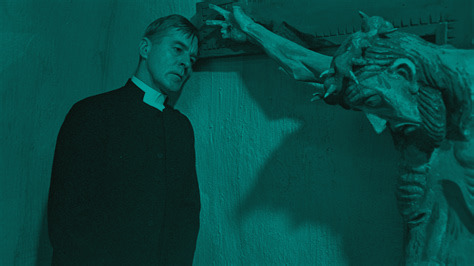

This bleak yet poignant second entry in Ingmar Bergman’s Faith trilogy sees a disillusioned priest seeing his uncertainty reflected in his parishoners.
Good grief.
I had heard at this point that Scandinavian cinema was going to be bleak, but I didn’t know just how deep this rabbit hole went. Turns out is goes way bleaker than I ever thought was possible. And not in the “I will be traumatized forever” category. More in the “I had no idea I was about to witness an existential crisis” kind of way.
Following up his deep dive into a family in crisis in Through A Glass Darkly, Bergman teams up again with cinematographer extraordinaire Sven Nykvist to tackle another spiritual meltdown in Winter Light. This time, it’s a priest, Tomas, who’s undergoing a crisis of faith. Suffering from a cold and tired of hearing God’s silence, Tomas tries his best to spread the Lord’s word to his dwindling congregation, even as the pressures from his own relationships try to draw him away, including his atheist ex-girlfriend Märta.
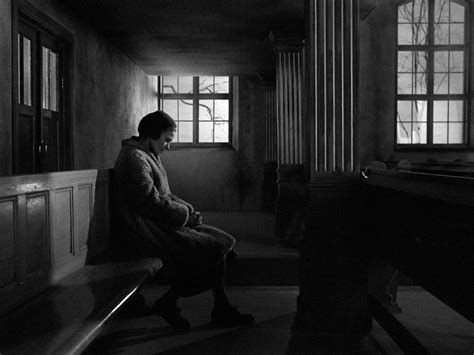
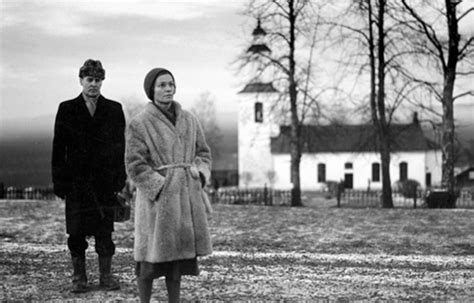
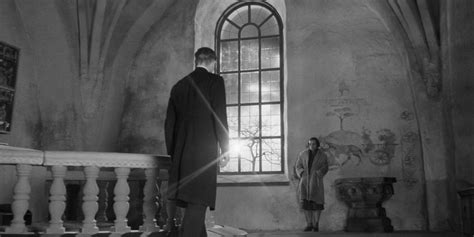
Unlike Through A Glass Darkly, I had to think harder about this one. I watched this right before I went to bed, which wasn’t the best decision. The filmmaking is a lot less stylistic here, leaving me less room to visually analyze what the characters were feeling. That’s not to say there isn’t a distinctive visual identity to Winter Light, but it’s more subtle and there’s more focus on the performances than the rest of the mise-en-scéne.
There’s certainly a lot going on underneath the surface. The opening scene is long and monotonous, as the small number of worshippers at Tomas’s church are paying attention with various degrees of intensity to the hymns and prayers of his words. When the scene finishes, Tomas retreats to his office, but Jonas, the local fisherman played by Max Von Sydow, follows him and reveals that he is undergoing a crisis of faith after learning that China has been building a bomb. However, to Tomas’s shock and dismay, he can only admit that he is undergoing a similar sensation, without providing any comfort or guidance to the poor man.
I give advice I won’t follow to people all the time, but Bergman makes it clear this isn’t normal for Tomas. He’s not corrupt, and he’s not immoral. He does want to preach to this congregation. But when God isn’t answering his prayers, what hope is there? There’s some thematic resemblance to Martin Scorsese’s Silence (2016), another film about Christian priests lamenting under God’s apparent indifference to their suffering. Whereas Scorsese dealt with the cross-cultural constraints of the priests’ missionary work in his film, Bergman reckons with the inner turmoil Tomas and the others are facing. When the leader can no longer trust his own words, what is he to himself?
This film knocked the air out of me, but it did so in a way that was reassuring. There’s no easy fix to an inner crisis of faith. Normally it would be up to a lovely female love interest played by a doe-eyed actress, and at first glance Märta seems to take up that role. Märta is an atheist, but she loves Tomas deeply, even after he hurt and left her many years ago. She tries her best to console him, but their respective wounds are too deep to fully heal. Even when they accompany each other through the darkest of times, the history holding them together weighs them down, to the point that the other’s company doesn’t bring comfort, but more misery. Ultimately, while they do love each other, they’re not right for each other. From now on, Tomas is on his own.
It should be isolating, but instead it’s freeing.
There’s this misconception that nihilism and fatalism are inherently negative outlooks on life. But if there’s little point in a higher or deeper meaning in something, that only means we are more in control of our own destiny. Although Tomas reaps the consequences of his own actions frequently throughout the film, he also knows that if he can go through one tragedy, he can dig himself out of another. Nothing is fully resolved, but life nevertheless trudges forward.
It’s miraculous for a film as depressing as this one that it manages to grasp one last particle of optimism. I wouldn’t even call it optimism, just a ray of hope. It’s not necessarily a direct sign things will get better, but after watching this film, you’ll be glad you’ve experienced it. Just don’t watch it if you want to have a good laugh.
FURTHER THOUGHTS
- Sven Nykvist will really make your jaw drop. That man knows how to work with black-and-white.
- Now I wish there would have been a collaboration between Winter Light and Sister Act. Whoopi Goldberg and Ingmar Bergman would have been quite the duo.
- A priest destabilizing an innocent man named Jonas? Sounds like Dark.
 BEYOND THE FRAME
Leave a comment