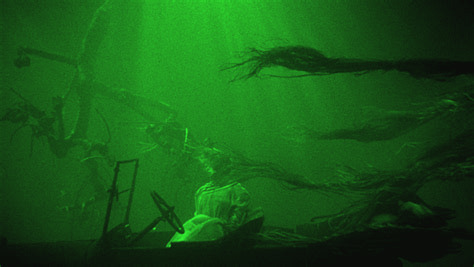
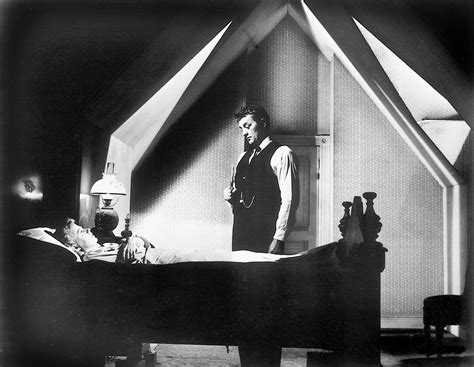
With just one directorial feature, Charles Laughton elevated the form of film noir through a deep understanding of lighting and a terrifying performance from Robert Mitchum.
When I was younger, I would often wake up in the middle of the night to get a snack or some water. However, no matter how many times, the fear of the dark never ceased. Maybe it was the feeling that something was lurking in the shadows. Maybe it was the strange noises from outside. Or maybe it was the sound of a looming darkness threatening to swallow me whole. Even though that fear has subsided and I have an immaculate ability to see in the dark, that fear still lingers.
I felt it consistently throughout The Night of the Hunter.
Released in 1955, it was a box office bomb and ended the directing career of successful actor Charles Laughton as soon as it began. Today, it has a much different reception as one of the pioneering films of film noir. Sure, it has the same influence from German Expressionism and the censorship of the Hays Code, but it has a distinguishing set of features that set it apart from its contemporaries, like The Maltese Falcon and To Have and Have Not. (Okay, those were the first two out the top of my head, and by some coincidence they both have Humphrey Bogart. Go watch them, they’re great, etc.)
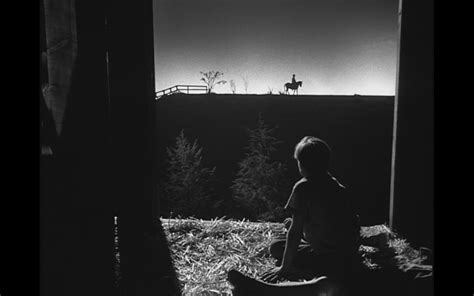
The Night of the Hunter centers from the perspective of a child, one of my favorite storytelling devices. When his father is arrested after stealing $10,000 and hiding it, the young John is forced into a difficult situation when his desperate mother marries the Reverend Henry Powell, a tattooed priest with sinister motives. Although no one will believe him because he’s a child and Powell is a well-respected member of the community, John sticks to his gut that Powell is a serial killer, even protecting his flighty little sister Pearl.
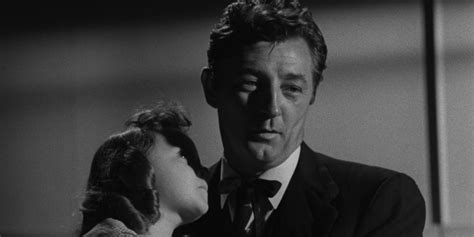
Much like The Silence and Pan’s Labyrinth, John might be a kid, but he’s not dumb. He’s also no less terrified. As he should be, as his stepfather Powell is a complete monster in sheep’s clothing. He at first seems charming, but as we see from the opening shots, he’s an unrelenting killer. Robert Mitchum knows what makes men like Powell tick; the worst part about killers is how they’re not obviously monstrous, but how they look just like everybody else. Powell gets along well with the rest of the community, but when he’s at home, he’s a different entity. He’s on the prowl, sniffing for any sign of treachery from John and Pearl. When he goes in for the kill, he looms like a vampire before striking the fatal blow.
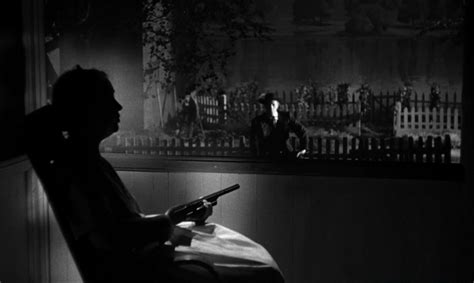
Charles Laughton’s directing and Mitchum’s performance could not go more perfectly well together. Laughton understands that lighting is one of film noir’s most defining features. He also understands that men like Powell weave in and out of the shadows, operating on a dual level above ordinary people. In one scene, as John tries to hide the money as Pearl plays with it outside, the front door opens and the haunting silhouette of Powell burns over them. In the theater, it sent shivers down my spine. Through this lighting, Laughton elevates Powell from an ordinary murderer to a truly frightening spectre.
But the directing doesn’t just elevate a man, but a community. The Night of the Hunter is a Southern Gothic picture, set amongst long and winding swamp rivers and neighbors who rely on patriarchal values and religion to guide them in difficult times. The townspeople in the film aren’t sanctuaries for the frightened children, but another block in the path to safety. Because they are blind towards Powell’s cruelty, they see no problem accepting what Powell says as truth. When they do realize it, they turn just as terrifying as the man they follow. Much like other noir films, there’s no simple black-and-white setting, just characters in varying shades of gray.
Towards the halfway point of the film, the story changes as the children encounter a brief respite in Rachel Cooper, a strong-willed orphanage head who leads her children to a brighter future through the Christian scripture. She’s a stark antithesis to Powell’s malignant form of Christianity, and her segment of the film is one of the most enjoyable to watch. It doesn’t help that she’s played by silent film legend Lillian Gish.
There’s a lot of discussion over which noir is the quintessential noir, but I would argue The Night of the Hunter is right up there. It encapsulates everything great about the genre, while containing as little melodrama as possible. It’s truly a work of art.
FURTHER THOUGHTS/
- Those townspeople were quite useless. When you see a man creepily singing hymns under his breath in his day-to-day life, you make like Rachel Cooper and get your shotgun out.
- Never in my life have I been so glad to see shrubbery slowing down somebody.
- Apparently John’s actor was quite a prick, which adds another level to Powell’s hatred.



Leave a Reply