
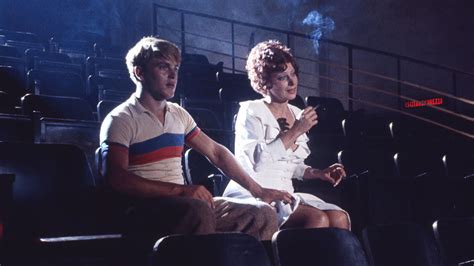
Fellini proves even a sex comedy about life during the height of Italian fascism can be profound, exhilarating, and subtly tragic.
In the opening scene of Federico Fellini’s Amarcord (1973), villagers welcome the arrival of spring with wonder at the puffballs floating through the air. The next thing they do is ceremoniously burn a puppet witch atop a bonfire, with villagers meeting in the town square to dance around in a circle, not unlike another climactic scene in 8 1/2.
One of my favorite memories I have from when I lived in Massachusetts was during an annual bonfire in the next town over, where leftover Christmas trees were used as kindle on a tiny beach. A lot of people came each year, and it was an astounding sight to watch. If you got too close to the fire, your eyes would dry up and you’d feel as if you were looking into the pits of hell. But everyone was so happy it was impossible not to feel joy.
Fellini understands that. Despite the film’s bleak setting in Italy’s fascist period in the 1940s, the film contains a rose-colored lens that it refuses to shake off. Normally this would lead the film to be accused of romanticizing and sanitizing a brutal history, but since it’s being told from the perspective of a privileged schoolboy in small-town Italy, all we get are glimpses of lustful crushes and adolescent hijinks. It’s easy to think during turbulent periods you’d be constantly inundated with memories of harm, but the truth is a lot more complicated.
For Titta, there are a few facts of life. For one, everyone loves Gradisca, a local hairdresser with curvy hips and a freespirited air. Two: school is a bore and he would rather spend his time with his friends, pranking other students and pining after other students. Third: his family is constantly yelling, bickering about this and that. Even though this place might be chaotic for some, Titta is more than happy to remain amongst these colorful group of characters.
Amarcord‘s central location of Borgo San Giuliano is loosely based on the town of Rimini, where Fellini grew up. Reading a biography about his life first piqued my curiosity about this film. I’ve moved around a lot, so I know how easy it is to get attached to a place and get reminded of it everywhere you go. It’s never easy to leave, but you start to look back on it affectionately, to the point where you start to leave out some of the less happy memories around that place. Fellini also understood how painful that could be. After he attained massive worldwide acclaim for his legendary pictures such as La Dolce Vita and La Strada (the first film to win the Academy Award for Best International Film), he almost seldom returned to the town, despite having strong feelings about the place.
Amarcord is silly, but it’s silly with a side of the sentimental. The characters are all goofy and outlandish in their own ways, but they have enough dimensions of relatability to them that you’re reminded of people you used to see everyday on the way to work. There’s the shop owner who you always had a crush on, the neighborhood boys who would terrorize everyone, the one old guy who wouldn’t stop musing about the town’s history, and the one person who knows everything about everyone yet refuses to tell.
The setting of the fascist periods adds to this picture of a small town. It’s not wholesome by any measure, but you start to get a picture of Italy during fascism that isn’t overly bleak. Sure, there’s relentless propaganda, but you become so desensitized to it that people accept it as part of their daily routines. One might even imagine getting married in front of a giant bouquet of the supreme leader’s face.
Occasionally there’s an incident involving a family member that thankfully doesn’t result in their death. But as terrifying as it is, people don’t dwell on it for too long. The memory lingers, but they have little choice but to move on.
Overall, the life of a small town during fascism Amarcord describes is one of constant myth-making. People mythologize a beautiful woman and see her as a prize to win at the end of the day. Young men with nothing to do try to find ways to get through the day. And as the seasons change, people flicker in and out of the town. But there’s still a memory of the poplar floweres blowing through the wind, bringing on a new season full of hope for a better future.
FURTHER THOUGHTS
- Winter in Amarcord reminds me of winters in Massachusetts. Except for the non-biting wind and the absence of road rage, of course.
- I don’t care how exciting it is, I would be fucking irritated if a bunch of sports cars violently drove down my street. I know the Mille Miglia is a huge thing in Italy, but I’ll pass.
- Surprisingly, this didn’t traumatize me. THANK GOD.




Leave a Reply