
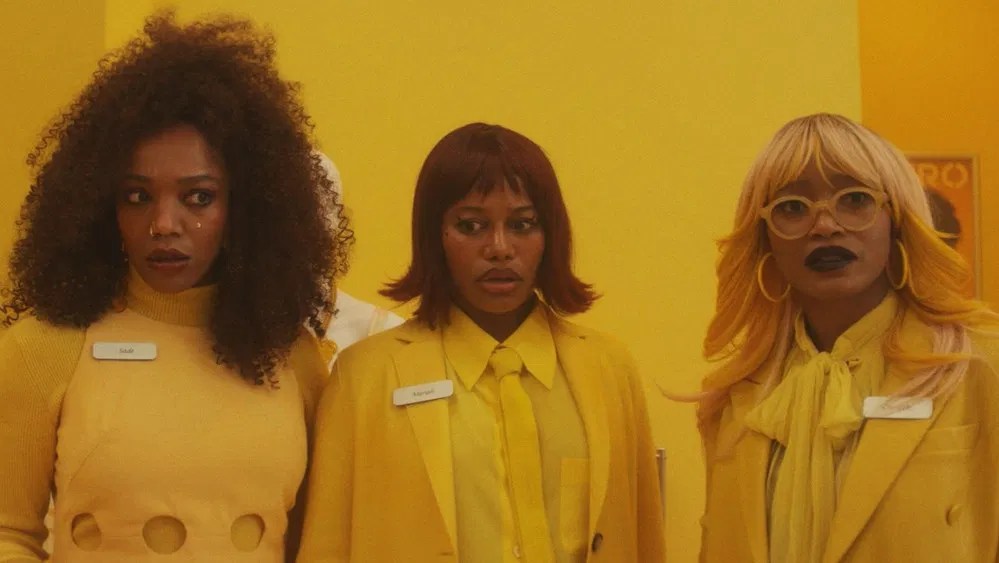
Right from the get-go, I knew Boots Riley’s I Love Boosters was not going to be like anything I’ve seen before. We start off with Keke Palmer’s Corvette entering a club, grooving along and flirting with a guy and inviting him up to her place. We think they’re going to get it on, but in reality she’s just there to sell him some of the stuff she’s “boosted” from department stores, selling them at a discount price to lower-income patrons. Although the man’s heartbroken, he asks for size ten shoes. Cue the eclectic font title sequence.
I Love Boosters is not a film that you watch, but a film you ride along with. The film follows the boosting Velvet Gang as they aim to piss off fashion mogul Christie Smith who looks down at them for being “urban bitches,” while the Smith herself steals the ideas and creations of the lower classes. Corvette, in particular, has a vendetta of her own. Along the way, they meet various other characters who are dealing indirectly with the absurd rat race of exploitative industry practices.
The film grabs you by the coattails and refuses to let you go through every absurd visual gag, every outlandish medium change, and every wild costume. You’d think it turn out to be a mess, but it’s clear that Boots Riley is not out to create a normal film about lower-class solidarity, where the colors are desaturated and brutal reality takes center stage. Instead of using poverty as a basis of unrelenting realism, Riley uses poverty as a jumping off point to explore radical possibilities of change.
For a film that deals with low-level crime, it doesn’t hesitate to explore the contradictions of anticapitalism. It’s easy to look at a films such as The Wolf of Wall Street and look at it as an indictment of hedonistic capitalism, but as much as you can try to fight it, there’s always one part of you that wants to be Leonardo DiCaprio. Corvette finds herself in a similar position. She admires Christie Smith (an excellently over-the-top Demi Moore) for her business acumen and genius, but she also hates her for looking down on her boosting, which is her only way for her to make a living and give back to the community. It doesn’t help that her friends Sade and Mariah have lives of their own too, and are struggling to support themselves already as is. Sade, in particular, has kids, so if they can’t make a living, that’s the end of the line.
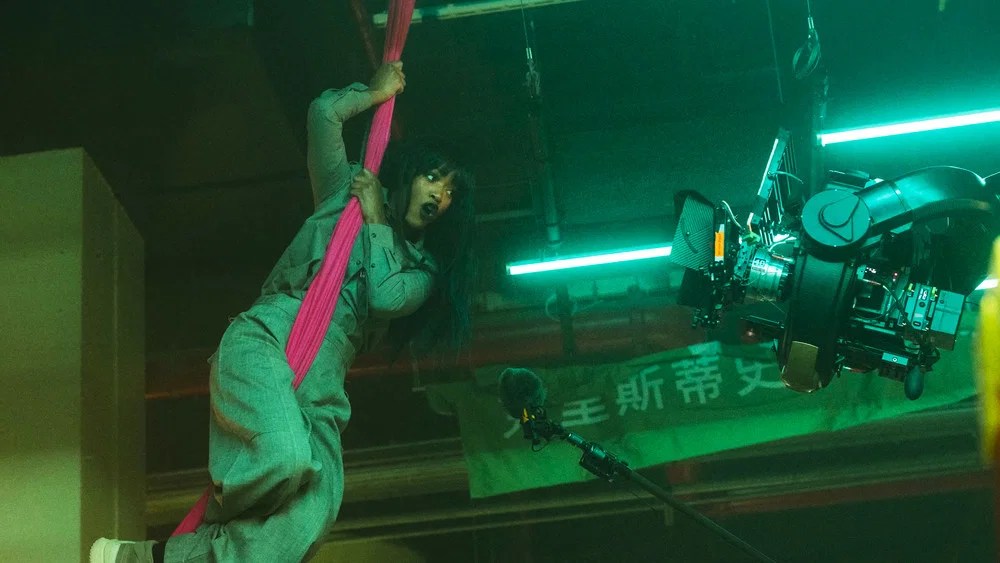
But the more they try to uncover a way to bring Christie Smith down a peg, the more they uncover just how deep the exploitation goes. They get hired at one of the department stores they’re targeting, only to find that some of the staff members are planning to unionize for longer breaks and more pay. Later on they find a teleporter from a booster from China who wants to raise awareness to the health risks of the workers who help make Smith’s clothes in the first place. Turns out there’s an entire lasagna of exploitation that keeps Smith at the top of social hierarchy, and the only thing they can do is to bring the implicit contradictions in the light.
One of the most impressive things about I Love Boosters is how it brings a lot of these complex themes into play without them bogging down the story. In tune with his eccentric style, Riley has the teleporter from China act as a way to bring out how the world around them is full of contradictions. Capitalism doesn’t just go one way–it practically brings everything together, while reinforcing the dominance of those on the top. At the same time, when you strip something down to its bare essentials, clothes are just a collection of fabric that are the product of the people who make them. You might think expensive clothes are exclusive to the rich and famous, but it’s a lot more complicated.
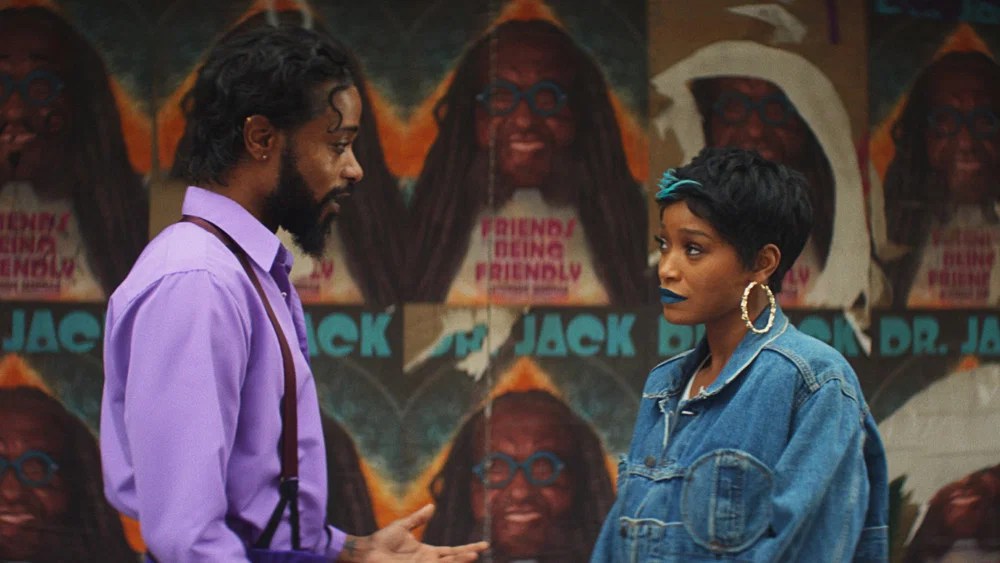
That’s not to say that everything in this film works. Lakeith Stanfield reunites with Riley as a mysterious stranger wearing a ring who pursues a relationship with Corvette, but it doesn’t really add anything new to the story, besides a crucial role in the third act. But it’s not enough to bring the film down. If anything, I Love Boosters succeeds because it refuses to dumb things down. It’s a celebration of “low” art, and a fun ride that refuses to take too many things seriously while taking time for pathos.
FURTHER THOUGHTS
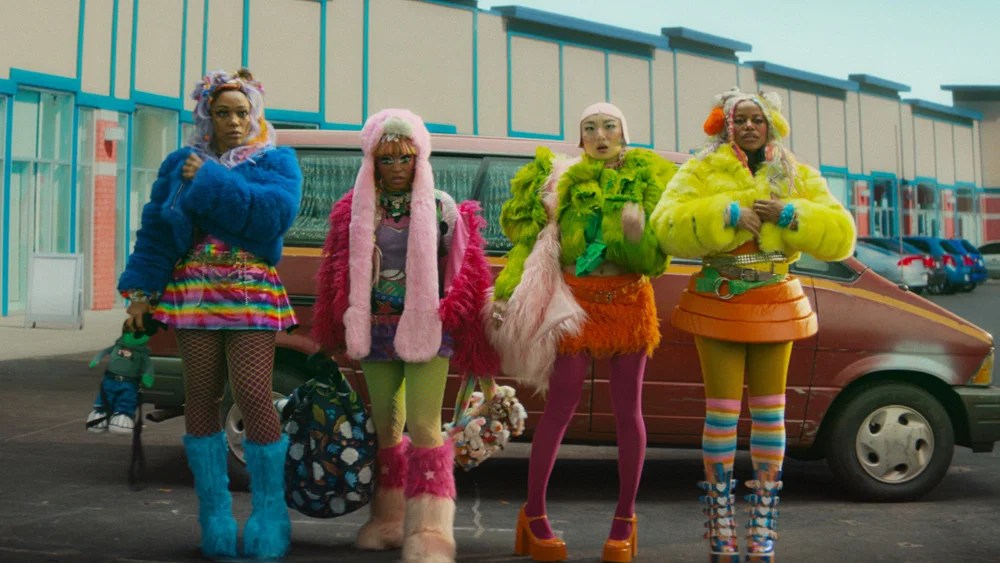
- My sister says I dress like a toddler on acid, and I’d say this applies very well to the costume design of the film, except it’s a lot more complimentary. I want every single design.
- I completely forgot who Don Cheadle plays in this. What a chamelon.
- Is it just me, or do monochromatic stores sound really good? Those seriously need to be a thing.




Leave a Reply