
You haven’t seen a film like this before.

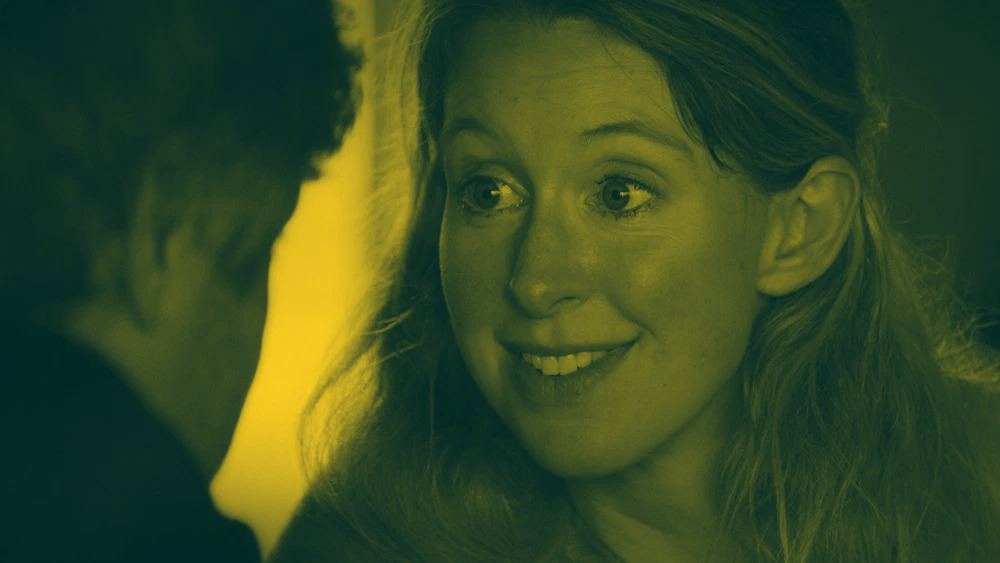
A group of women wearing black niqabs sit on a beach, motionless while their husbands and sons play on the beach wearing nothing but swimming trunks. A woman, Leila approaches them, wearing a flowing white dress that sharply juxtaposes her with these women. But she is just like them. Hailing from Lebanon but living in London, Leila is still stuck on a beach, with all the promise of freedom, but constrained by memory and intergenerational trauma.
Leila and the Wolves has an incredibly provocative structure. Living in London, Leila is putting together an exhibition of photos of Palestinian resistance throughout the 20th century, from the 1920s to the 1970s. However, she wants to place emphasis on the female corners of resistance that has gone unnoticed by history. However, her boyfriend dismisses this, not believing that Palestinian and Lebanese women stayed at home and had no part in the fighting. Angry at this slight of history, Leila decides to travel back in time and witness history herself.
Throughout much of Western history, we’ve become accustomed to the idea that Middle Eastern women were not participants in active resistance, and that instead they were kept silent from their abusive husbands and patriarchal societies. This justification has often been used to partly justify invasions of other countries, like how US Representative Carolyn Maloney wore a burqa on the House floor to argue for invading Afghanistan to free women from tyrannical sexist rule. But what does this mean for women who are already fighting for feminism in the Middle East?
Leila and the Wolves look at female resistance through multiple different avenues. When British soldiers come storming through the streets with guns, women throw objects and projectiles from their windows, sometimes even a pot of boiling water from their balconies. They smuggle in weapons to hidden resistance fighters by posing as a wedding party. Some even argue for participating in the armed resistance itself, although not without great and personal risk to themselves.
But it’s not just on the warfront they are fighting. In one scene, a woman who is active in the resistance is abused by her husband for bringing in a cold meal. Her sister tries to console her by giving her advice on how to improve her cooking, saying that her husband will cool off. In a sequence in the 1970s, growing feminist voices within anticolonialist movements argue for more equality, only to be met with blunt dismissal from their male colleagues. To the movement, these women see themselves as vital partners. But to the men in their lives, they are an inconvenience, and a possible danger to the movement’s vitality.
Heiny Srour is also dedicated to showing the different discourses around female resistance, especially in an intergenerational context. Every woman in this film knows what they are fighting for, and on some level they all understand one another. But the world they are living in is harsh, and depending on what year they were born and what conflict they were born into, they all have different methods on how to proceed. For some of the older women, getting divorced is just as, if not more, worse than having your husband die. When a mother finds out her husband has forbidden her daughter from going to school, she goes over to comfort her before returning to her laundry. The younger generations are more determined than ever to relinquish the chains that have bound them, but their frustration at the older generations is part of what makes the film so heartbreaking to watch. No matter what they do, sometimes the worst obstacles can come within your own community.
Leila and the Wolves is not just a political film, but one that is full of affect and emotion that has been deeply felt across generations. The first scene involves Leila imagining herself as an older women, forgetting all of her female relatives as her memory turns to mush. She refuses to forget, and in this refusal the journey starts. When she looks in the mirror, she wants to be part of a tapestry of women who have consistently chosen to look tyranny in the eye. She doesn’t want to be defined by rigid notions of gender. She wants to give voice to the forgotten women, and hopefully gain a stronger voice of her own.


FURTHER THOUGHTS
- Rafiq is just a lazy boyfriend. I would’ve dumped him from the beginning, IMHO.
- I don’t know what kind of bread they were making halfway through the film, but I want some.
- Man, I love films that just know what to do with beaches.



Leave a Reply